Grover Norquist Quotes
We didn’t give them permission to repeal the ethanol subsidy. We just told them that it would not break the pledge that they had made …
He was referring to Bill Clinton’s concern that Republicans needed Norquist’s permission before voting for legislation involving taxes and subsidies. See {623266} . Norquist was a modern day Party Boss. He controlled a number of large PACS conservative lobbyists. His “issue” at the time was that no one should allow Congress to do anything unless it was agreed that under no circumstances that would there be taxes of any kind passed and no tax loopholes would be closed. He required Republican candidates and members to sign a pledge before he would give them any campaign money. About 90% did. A generally agreed bad law was a tax subsidy for farmers who grew corn for ethanol. Most Americans wanted to repeal it. Norquist sent letters to the Republicans telling them that voting for repeal was ok and he would not see it as violating their pledge.
Grover Norquist, Founder, Americans for Tax Reform, Executive Director, National Taxpayers Union, Republican Strategist, Interview, CNN The Situation Room, July 13, 2011
Sourced by: Eigen's Political and Historical Quotations

Norquist was a modern day Party Boss. He controlled a number of large PACS conservative lobbyists. His “issue” at the time was that no one should allow Congress to do anything unless it was agreed that under no circumstances that would there be taxes of any kind passed and no tax loopholes would be closed. He required Republican candidates and members to sign a pledge before he would give them any campaign money. About 90% did. A generally agreed bad law was a tax subsidy for farmers who grew corn for ethanol. Most Americans wanted to repeal it. Norquist sent letters to the Republicans telling them that voting for repeal was ok and he would not see it as violating their pledge. See Norquist’s response {623265} .
Actually, Clinton was historically wrong. There have been several occasions in American history where an unelected party boss was able to control and veto the Congressional actions of members of their own party. However. The earlier occasions were in the 19th century—Norquist was the first of the party bosses to amass that kind of control in modern times.

Many corporations getting corporate welfare in the form of subsidies and tax breaks often to not even perceive that they are taking something from the government. They sometimes think that they create jobs and the workers in turn pay taxes to the governments so the subsidies or other benefits that they are getting from government is an "investment" by government. Of course that usually do not perceive it to be a government investment to pay for training for an unemployed worker, or heath care for the poor who in good health might be working. That is welfare.

The Republicans lost the Congressional election of 2006. See {616069}.


The Republican Majority of the House, when Hillary Clinton, the former Secretary of State, was running for President, established a select committee to investigate an incident that occurred in the State Department during Clinton's term. However, there already had been both House and Senate hearings and numerous investigations of the same incident. This committee uniquely was established with no deadlines to finish their work and an unlimited budget. Soon it became clear that the focus of the Republican efforts was on Mrs. Clinton and not on State Department activities except as how they might be negative to Clinton. Even leading Republicans admitted that the majority had abused its Congressional power to investigate to achieve primarily partisan advantage. See {582958} for Hanna's later statement when he incurred the ire of some of the Republicans for his admitting the truth.
In 2015, a group of hyper-partisan Republicans initiated yet another investigation of the attack on an American Consulate in Libya where the U. S Ambassador was killed. The incident had occurred when Hilary Clinton had been Secretary of State some time earlier. However, she was then the leading Democratic Candidate for President, and some Republicans wanted to question her under oath in the hopes that they could find something to embarrass her and derail her surging campaign. Hanna and a few other Republicans admitted the truth as they were opposed to the abuse of the Congressional power to investigate for partisan purposes. However, the reaction against Hanna by some members of his own party was extremely harsh. The theory of the Hanna critics was that telling the truth was in this case highly embarrassing to the Party and damaged the credibility of many accusations made against Mrs. Clinton who turned the tables on the investigators in when they questioned her for over 11 hours straight, and despite the total absurdity of the hearing and the questions—all of which had been asked before, she comported herself with Presidential dignity and pretended to take the hearings very seriously and answered the same loaded questions repeatedly. See {582957} for his earlier statements.


Louis had maintained that the earmark was a cowardly and corrupt way of a congressman bringing pork back to their districts and paying back campaign contributors. He argued that if what the Congressmen were doing were right, why not introduce a bill publicly, debate it, defend it, and try to get a majority for it rather than sneak it in some large piece of legislation without anyone knowing who even introduced the legislation or got the pork into the bill.


After he went to West Point, Eisenhower was very non-political until Republican leaders invited him to run for the Presidency as a Republican.


Many members of his own party opposed some of the President's policies and programs, and party loyalty and discipline were strained:

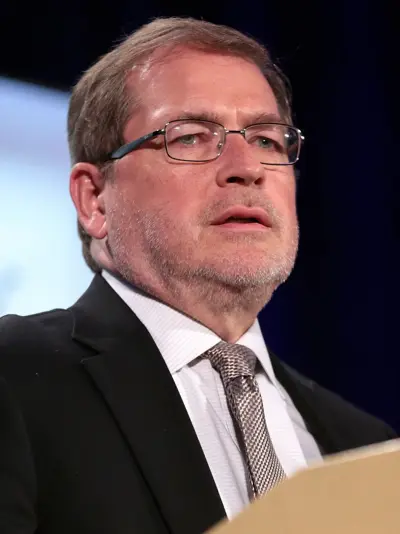
- Born: October 19, 1956
- Nationality: American
- Profession: Political
Grover Glenn Norquist is an American political activist and tax reduction advocate who is founder and president of Americans for Tax Reform, an organization that opposes all tax increases. A Republican, he is the primary promoter of the Taxpayer Protection Pledge, a pledge signed by lawmakers who agree to oppose increases in marginal income tax rates for individuals and businesses, as well as net reductions or eliminations of deductions and credits without a matching reduced tax rate. Prior to the November 2012 election, the pledge was signed by 95% of all Republican members of Congress and all but one of the candidates running for the 2012 Republican presidential nomination.
