Nazi Party Quotes
We demand: … an end to the power of the financial interests. We demand profit sharing in big business. We demand a broad extension of care for the aged. We demand … the greatest possible consideration of small business in the purchases of national, state, and municipal governments. In order to make possible to every capable and industrious [citizen] the attainment of higher education and thus the achievement of a post of leadership, the government must provide an all-around enlargement of our entire system of public education … We demand the education at government expense of gifted children of poor parents … The government must undertake the improvement of public health – by protecting mother and child, by prohibiting child labor …. a permanent recovery of our people can only proceed from within on the foundation of the common good before the individual good.
This platform was not very different from those of many democratic political parties at the time. It was on this sort of basis that the German Nazis were elected. However the last sentence of this quotation turned out to be the undoing of the German people and most other people throughout Europe. The “common good” always was interpreted to be the good of the Nazi government which had been elected as against the individual god—the rights of the individual. Soon the state had all the rights and individuals, none. And no other political force could contest and election as that was not in the interest of the common weal.
Nazi Party, Germany, Party Political Program Adopted, Munich, February 24, 1920
Sourced by: Eigen's Political and Historical Quotations

Although the Nazis railed against the Communists & Socialists, the potential opposition they feared the most was the middle class. See also {582967}.


He defeated Adolf Hitler at the polls in 1932, but the next year he was compelled to yield to Nazi power and appointed Hitler Chancellor of Germany.


RSD Party platform. The Russian Social Democratic Party was in 1887 a very modern democratic party inside the feudalism of Tsarist Russia. The Tsar and the nobility thought them wild radicals and yet their party platform was not only reasonable, but in large part influenced by the American Constitution, Bill of Rights, and then current practices in America. It is hard to believe but at the time a Russian could not work at an occupation he chose but could only do the work that was permitted by the aristocrat who owned the land he lived on. The Tsar, Alexander III, was a terrible autocrat, unlike his father who had desired some reform and abolished serfdom. All efforts at any kind of Democratic reform were put down, and Russian reformers in this party tended to split between those who still hoped for reform and those who saw violent revolution as the only hope. By 1906 the party which had no success at any of their planks of reform had split into two main subgroups—the Mensheviks and the Bolsheviks—both active revolutionary groups, but the Mensheviks tended to be more democratic and moderate and wanted to include the workers and the middle class whereas the Bolsheviks saw the middle class as part of the problem and argued for a more radical political structure. The real split occurred after the 1917 revolution when the Mensheviks lost popularity among the Russian revolutionists as not being radical or realistic enough in what it would take to transform Russia. The Bolsheviks gained control and by 1921, they had outlawed and purged the Menshevik party. That was the last hope of democracy in Russia, as the Bolsheviks model was that which guided the country until the fall of the Soviet Union.

This is an important quotation because it shows that Franco was not only a Fascist but one who supported and approved of Hitler personally and his criminal programs. Most Spaniards have thereafter regretted that the Spanish Dictator could take such a murderous and inhumane position on behalf of the Spanish people. Franco was supported only by some of the very wealthy, part of the military and the Catholic Church leadership. The latter also makes this quotation important, in that it is very doubtful that the Spanish church leaders would support Hitler if the Pope and the Vatican were opposed to Hitler and the Nazis. Yet some Vatican representatives have maintained that the Pope was definitely opposed to Hitler and Nazism, but the evidence for this is not strong. This quotation tends to lend more credence to the Papal critics.

The historical record that is available shows that while the Pope did not, actively or aggressively oppose Hitler, and he did not discipline Catholic prelates who were Nazi supporters, there is no specific evidence that shows the Pope conspired with Hitler, about the extermination of Jews or anything else. However, most of the relevant documents of the era are in the Vatican and the records have been sealed and have not been visible to historians. Apologists for the Pope’s passivity point out that a large percentage of Germans were Catholic and he had a duty to not antagonize Hitler who would retaliate against German Catholics and the German Catholic clergy and church property. Further, Fascist Italy was under Hitler’s control, and the Vatican itself could have closed and its property seized. The historical record is still very vague.

Although a fervent Nazi, he detested Hitler. When Hitler consolidated power, one of the first things he did in 1934 was to order his guards to murder Strasser, just as Strasser had feared.

He had been the President of the German Reichsbank under the Weimar Republic and had real credentials as an Economist. Many Europeans and Americans assumed that he could not be as apparently irrational as the Nazi rhetoric at the time. However, he had become a committed Nazi as this quotation demonstrates. Most of the professional men of Germany became Nazis out of conviction or as a means of getting ahead or maintining their position. Given the solid anti Fascist character of the overwhelming majority of Germans at the beginning of the 21st century. It is hard for most of us to believe that most of the Germans were ideological, Fascist, Right Wing, extremist fanatics, but the German national character transition has been remarkable and is in great part the result of a painful self examination of German history and men like Schacht.


General Motors in Germany had started manufacturing trucks for the Nazi regime. Ford also was building dual use—military and civilian—vehicles. A number of American corporations, with World War II having started in Europe, owned subsidiaries in Nazi Germany which under Nazi laws and regulations were required to produce products for the Nazi government. IBM machines were being used to keep track of all the anti-Nazis, Jews and other perceived “enemies”. Nazi contracts were very profitable and most American firms in Germany just closed their eyes to what the Nazi regime was doing and even fired their Jewish workers rather than close down their German factories. With this horrible experience with large corporations helping what was to be our enemy, after WW2 Congress passed legislation which allows the President to make it illegal for American firms to trade with, manufacture in, or provide technical assistance to Countries that are potential enemies.

He was a viscious anti-Semite who attracted to his party extreme right wingers, Nazi Sympathers and apologists for the Vichey Franch government. The party was rejected by the majority of French voters, but when his daughter took over the party, she was not an anti Semite but foudn it hard to shake the party's image which was alaysa associated with her name even when she actually kicked her father out of the party.


Although the Nazis railed against the Communists & Socialists, the potential opposition they feared the most was the middle class. See also {582966}.

He had abdicated and was serving as the Governor of the Bahamas at the time. While the public was given the reason for has abdication as his love for a divorced woman, his pro Nazi viewpoints which were not publicly known in England, made him unacceptable and his treason a danger to England at war with Nazi Germany.

Devolution is the decentralization of government. Wales and Scotland were originally countries different from England. They came under the control of a single king but recently have obtained more autonomy—not unlike states in the United States. This reform was opposed by some politicians.
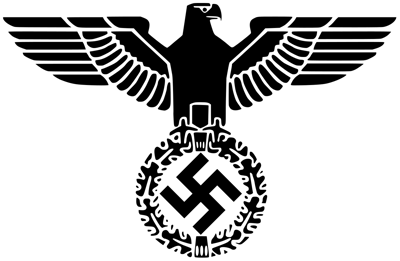
The Nazi Party, officially the National Socialist German Workers' Party (German: Nationalsozialistische Deutsche Arbeiterpartei or NSDAP), was a far-right political party in Germany active between 1920 and 1945, that created and supported the ideology of Nazism. Its precursor, the German Workers' Party (Deutsche Arbeiterpartei; DAP), existed from 1919 to 1920. The Nazi Party emerged from the German nationalist, racist and populist Freikorps paramilitary culture, which fought against the communist uprisings in post-World War I Germany. The party was created to draw workers away from communism and into völkisch nationalism. Initially, Nazi political strategy focused on anti-big business, anti-bourgeois, and anti-capitalist rhetoric, although this was later downplayed to gain the support of business leaders, and in the 1930s the party's main focus shifted to antisemitic and anti-Marxist themes.
