Hjalmar Schacht Quotes
My so-called foreign friends do neither me nor the situation nor themselves any good when they try to bring me into opposition to the allegedly impossible National Socialist economic theories and declare me to some extent the protector of economic reason. I can assure you that everything I say and do has the complete approval of the Fuhrer and that I would not say or do anything that does not have his approval.
He had been the President of the German Reichsbank under the Weimar Republic and had real credentials as an Economist. Many Europeans and Americans assumed that he could not be as apparently irrational as the Nazi rhetoric at the time. However, he had become a committed Nazi as this quotation demonstrates. Most of the professional men of Germany became Nazis out of conviction or as a means of getting ahead or maintining their position. Given the solid anti Fascist character of the overwhelming majority of Germans at the beginning of the 21st century. It is hard for most of us to believe that most of the Germans were ideological, Fascist, Right Wing, extremist fanatics, but the German national character transition has been remarkable and is in great part the result of a painful self examination of German history and men like Schacht.
Hjalmar Schacht, 1877–1970, President of the German Reichsbank, Nazi Germany Minister of Economics, Speech in Leipzig, March 4, 1935
Sourced by: Eigen's Political and Historical Quotations


This platform was not very different from those of many democratic political parties at the time. It was on this sort of basis that the German Nazis were elected. However the last sentence of this quotation turned out to be the undoing of the German people and most other people throughout Europe. The “common good” always was interpreted to be the good of the Nazi government which had been elected as against the individual god—the rights of the individual. Soon the state had all the rights and individuals, none. And no other political force could contest and election as that was not in the interest of the common weal.

He defeated Adolf Hitler at the polls in 1932, but the next year he was compelled to yield to Nazi power and appointed Hitler Chancellor of Germany.

This is an important quotation because it shows that Franco was not only a Fascist but one who supported and approved of Hitler personally and his criminal programs. Most Spaniards have thereafter regretted that the Spanish Dictator could take such a murderous and inhumane position on behalf of the Spanish people. Franco was supported only by some of the very wealthy, part of the military and the Catholic Church leadership. The latter also makes this quotation important, in that it is very doubtful that the Spanish church leaders would support Hitler if the Pope and the Vatican were opposed to Hitler and the Nazis. Yet some Vatican representatives have maintained that the Pope was definitely opposed to Hitler and Nazism, but the evidence for this is not strong. This quotation tends to lend more credence to the Papal critics.

Although a fervent Nazi, he detested Hitler. When Hitler consolidated power, one of the first things he did in 1934 was to order his guards to murder Strasser, just as Strasser had feared.


Ford was a great admirer of Adolf Hitler who thought Ford was the greatest of the Americans. He was an inveterate Fascist—racism and all. He vehemently opposed United States entry into WWII against the Nazis. He was awarded a medal by Hitler, and he had no qualms about taking it.


Although the Nazis railed against the Communists & Socialists, the potential opposition they feared the most was the middle class. See also {582967}.

Frau Wagner was one of several agents of Nazi Germany sent to the United States to develop good will for Germany and funds for Hitler. Anti-German feeling was still high from the First World War but America had its share of right wingers like Ford. Hitler and Ford were mutual admirers. See {586988} for Hitler’s view of Ford.

This would be the beginning of the Nazi regime in Germany.


This quotation is important because there are some who believed that the professional German Soldiers did not respect Hitler and his murderous policies. This quotation shows that at least publicly Donitz had no problem extolling Hitler above all others. After the war Donitz was found guilty of Unrestricted Submarine Warfare and using thousands of slave laborers in his shipyards. He was sentenced to 10 years, one of the lightest sentences if the German War Crimes Trials.

The historical record that is available shows that while the Pope did not, actively or aggressively oppose Hitler, and he did not discipline Catholic prelates who were Nazi supporters, there is no specific evidence that shows the Pope conspired with Hitler, about the extermination of Jews or anything else. However, most of the relevant documents of the era are in the Vatican and the records have been sealed and have not been visible to historians. Apologists for the Pope’s passivity point out that a large percentage of Germans were Catholic and he had a duty to not antagonize Hitler who would retaliate against German Catholics and the German Catholic clergy and church property. Further, Fascist Italy was under Hitler’s control, and the Vatican itself could have closed and its property seized. The historical record is still very vague.


When the Nazis took over the German government, Schrodinger, a world famous scientist, at one of his major scientific lectures, gave an analogy that was critical of Hitler and the Nazis. The crowd of scientists wildly applauded. The Nazi agents took note of the speech. In 1938 Hitler had solidified his hold on Germany, Schrodinger was threatened with loss of his academic position and possibly a concentration camp. Since the scientist was so world famous, the Nazis persuaded him to issue a public statement of loyalty of which this quotation was part. It was published in all the German newspapers and scientific journals. Later, in the midst of WWII, Schrodinger was fired anyway on the grounds of “political unreliability”. See {629746} for Schrodinger’s letter of apology to his colleague Albert Einstein for his weakness in issuing the original apology.

Before there were supermarkets, different produce was sold in different stores. Grocery stores run by grocers, sold fruits, vegetables, cereals, and canned goods but not meat of fish which had their own special stores.
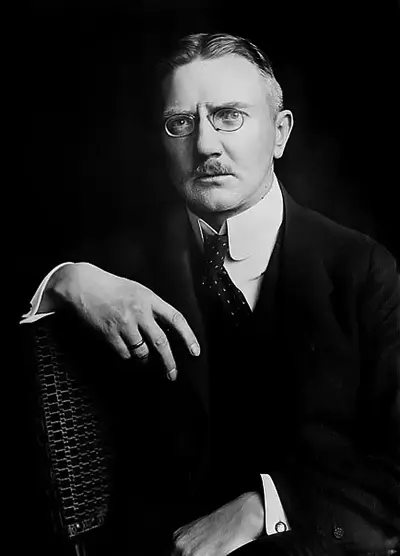
Hjalmar Schacht was a German economist, banker, centre-right politician, and co-founder in 1918 of the German Democratic Party. He served as the Currency Commissioner and President of the Reichsbank under the Weimar Republic. He was a fierce critic of his country's post-World War I reparation obligations.
