Muhammad Ali Jinnah Quotes
We could have a Moslem area run by Moslems as a part of the British Empire.
India was soon to be granted Independence by the Labor Government, much to the chagrin of Winston Churchill and other Conservative politicians who wanted to diminish the British Empire as little as possible. Jinnah, not wanting the majority Muslim areas of India to be part of a Hindu majority India, came up with this clever alternative. Britain would grant independence only to the Hindu parts of India and the remainder—Pakistan—would remain in the Empire as an autonomous colony. Many of the British politicians believed that that would be a constant friction in the Empire as many of the "Pakistanis" would then want their own independence and use the terror tactics to fight for it. Besides, the Conservatives did not have enough votes to stop Independence to all of India. Jinnah's efforts however were enough to lengthen the debate in the British Parliament thereby delaying independence for all of India and angering the pro-independence leaders throughout India. Jinnah, by then an autocrat, did this in secret, behind the backs of his own Muslim colleagues, many of whom had Independence as their highest priority.
Muhammad Ali Jinnah, 1876-1948, Founder of Pakistan and First Governor General, Offer to British Conservative Politicians, 1940, Quoted in Nisid Hajari, Midnight's Furies: The Deadly Legacy of India's Partition, 2015
Sourced by: Eigen's Political and Historical Quotations

One of the ideas to implement the Partition of India to create a Muslim Pakistan was to have plebiscites in many provinces to vote on whether the Province should remain with India or be a part of Pakistan. The Punjab was the largest of the mixed religion areas in question but the Punjab governor was opposed to the idea as most of the voters were illiterate and the Pro Pakistan forces would couch the alternatives in stark religious terms to the Muslim voters who will not realize that they could remain as Muslims in India just as they were at the time. In a number of areas—Kashmir being the most notable—there were a majority of Muslims yet enough of them preferred to remain with India than be part of Pakistan as they were Islamic moderates and did not want to be part of a Muslim Pakistan that might pressure them or force them to a more rigid form of Islam. Also many valued democracy and religious freedom. Some doubted Pakistan's likelihood of thriving in its own and preferred the stability of India.

Jinnah and other Muslim leaders had stirred up the Muslims to violence to put pressure on all the parties to accede to Jinnah's Muslim League's demand of an independent Muslim nation—Pakistan. Messervy was very sympathetic to the Muslim leadership as he had been feuding with and frustrated by the predominantly Hindu ruling Congress Party. After partition he accepted the mercenary position of Commander in Chief of the Pakistani Army. Then he was shocked and horrified at the slaughter of the terrorist attacks by the Muslims—about 4,000 Sikh men, women and children had been beaten and cut to death. The Sikhs had been targeted largely because Sikh leaders had recently announced that if there were a Partition, Sikhs would refuse to live in nation under Muslim control.

Singh turned him down. Note that even before Pakistan was a country, Jinnah and other Muslim leaders had hopes of grabbing much of India as the British partitioned it, and have been trying to do so ever since the inception of Pakistan

Two months earlier, Jinnah and the Muslim League had, behind the scenes, orchestrated and abetted vicious, murderous, terrorist attacks on Sikhs by Muslim tribesman brought into the Punjab for the purpose." Master Tara Singh
The Sikh's had a long history of living under Muslim domination and wanted no part of any more. Patiala was within the Punjab and Jinnah was insisting that the Punjab should be a Province of the new Pakistan because the Punjab was majority Muslim. However, there were many Sikhs, as well as some Hindus, Buddhists, and Christians and none of these wanted to be a part of Pakistan. Further, a significant portion of the Muslim Punjab population also would prefer to join India for many reasons, not the least of which was that they had become used to a democracy where they had complete freedom of religion and civil right as well, and with the exception of Turkey none of the Muslim countries were democratic and based on the Muslim League which did not democratically elect its leaders, Pakistan would not likely be a democracy that guaranteed civil rights (and they were right). So the majority of the people of the Punjab were opposed to becoming a part of Pakistan. The Sikhs were passionate opponents of being a part of Pakistan.

This famous quotation, from this important address, at such a critical time in history has been admired for years. Despite his great oratory, the next months were to see almost 2 million Indians of all faiths killed in what was probably the worst internecine violence in human history. Ironically, the politically motivated terrorism had stopped since all the decisions had been made. The motivation for the frightful atrocities that took place from then on was vengeance and fear of more vengeance." 1st Earl Mountbatten of Burma
Even into the 21st century, the problem was not solved and Muslims from Pakistan continue their futile but tragic terrorist tactics to try and acquire more territory from India." 1st Earl Mountbatten of Burma


This is one of the early calls for a partition of India which was to be so disastrous after the Second World War. The “free Muslim state of states” turned out to be Pakistan where they have been fighting amongst themselves about how much Sharia would prevail.
The Muslim League was demanding that the Punjab become a part of Pakistan when independence was granted later. However, the Hindus, Sikhs, Buddhists, and Christians were all adamant that they would not live in a Muslim nation which would soon become a de facto theocracy if the British could not control them. The Punjab was divided between India and Pakistan, and hundreds of thousands died in Sikh-Muslim attacks and then Hindu-Muslim conflict in the Punjab.
The throwing of flaming torches to burn out members of the other religion got out of control and the fires spread to the homes of all residents. The fires were so prevalent that the riot was then and has since been referred to as the "Shahalmi Gate Blaze". At the time Jinnah was horrified at the violence, but by the following year he and other Muslim League leaders were aiding and abetting Muslim terrorist attacks to put pressure on the government to create a separate Muslim state upon Indian independence—Pakistan. Most historians agree that the Muslim terrorism in the short run had worked, as it would have been unlikely that India would have been partitioned in the absence of violence. However, it set in motion a cultural pattern of religious hate, bigotry, intolerance, violence and murder which would plague Pakistan thereafter. The politicians throughout the country's history have tried to use the Muslim religious, fundamentalist, extremists for their purposes only to find that the fanatics were out of control and the entire Pakistani population has lived in fear, lest an extremist decide that what they did or say was inimical to Islam and assassinate him or her. They have assassinated even the highest levels of politicians—President, Governors of Provinces, National Legislatures as well as Journalists, writers and academics. But the average Pakistani citizen has always been at risk of brutal murder with hundreds killed every year in an atmosphere of total impunity for the murderers. They have even murdered married women who had been raped on the grounds that they were adulterers and were therefore stoned.
He was echoing proposals that he made in the Delhi Emergency Committee that had been called to cope with the butchery and murder when the Hindus and Sikhs were trying to leave the areas that were to be part of Pakistan under the Partition and the retaliations against the Delhi Muslims who were trying to flee to the new Pakistan. Unfortunately, the Muslim leadership did not want such a truce as while the land had been partitioned, Indian Money, military equipment, and other resources were yet to be divided and the Muslim leaders who had been so successful playing the violence card to gain and independent Pakistan, did not want to give up that option in the remainder of the division of India. Also, it was not at all clear that the Muslim political leaders could even then control the mobs who they had already whipped up to violence.

This quotation is often used as the antithesis of national pluralism. When India was partitioned, there were Muslims and Hindus both who subscribed to this view. The result was vicious interethnic slaughter and ethnic cleansing. However there was a large middle ground who did not accept this monocultural view of a nation. Many millions of Indian Muslims chose to stay in India as minorities and there were 200 million Muslims in India by the beginning of the 21st century. Modern India, is along with the United States, one of the leading ethnic and cultural pluralistic countries in the world. Pakistan was and still is totally monolithic. But it was India where Muslims have much more freedom than there Islamic brothers in Pakistan which although all Islamic constantly has better strife and killings over the degree of orthodoxy the State religion should take.
As early as 1933, 14 years before Indian independence, there was a movement for a separate Muslim nation within India. Ironically, Hindu India was never a nation in any sense of the word, but was a series of independent principalities much like Italy before its unification. However, with the Muslim conquest of the various Indian states, there was a central authority, ruler, and nation for the first time. Later the Muslims had to argue that India was not a country when it was they who had made it such. When the Muslim Emperors were in power, they argued that India was one country under their authority. But when they lost power, the Muslims argued the other side of the issue.
This was the first call for a separate Indian Islamic State. 17 years later Pakistan was to be born.

That is exactly what happened. However it would not happen until after the Second World War.
Muhammad Ali Jinnah and the other Muslim League leaders wanted to stir up India's Muslims in order to prevent Indian Independence from Britain unless India were partitioned and the Muslims could have their own nation. At that point the British and the Congress Party of India—the majority political party were both starting to plan for independence. Jinnah and most of the Muslim nationalists did not want to have Muslims in a Majority Hindu nation. To stop it, they first used fear to try and separate the many Indian Muslims who were politically active from their roles in and loyalty to the Congress Party which although Hindu dominated had Muslim members and officials. All the Muslims who were literate were aware of the terrible revelations of the Nazi Concentration Camps and the attempted extermination of all the Jews of Europe. The "party line" of the Muslim League was that once the British turned the government of India over to the Congress Party, they would turn on the Muslims and exterminate them so that India would be all Hindu. There were no such plans or even suggestions be anyone in the Congress party, the paranoia and the conspiracy theory resonated with many Indian Muslims just as conspiracy theories are believed by some people in every society. In this case, the paranoia that was unleashed by the Muslim League would have tragic consequences as with Independence getting closer many Muslims struck out and preemptively attacked and butchered Hindus and Sikhs who retaliated in kind and the butchery went on all through the Independence process and the partition of India to create a Muslim state—Pakistan. Almost 2 million people would be murdered in the sectarian violence that was unleashed.
There were several difficulties in this definition even for those British and Indian Congress leaders who were willing to accede to an independent Muslim state. Two of the most important where the definition of areas. They could be so defined as to include majority Hindu or Sikh areas surrounded by larger majority Muslim areas—the classic problem of boundary districting and redistricting. This was an insurmountable problem in the Punjab and elsewhere. The 2nd was the undemocratic nature of the demand. The Muslim League, unlike the Congress Party, had never had a very large participation and its leaders were never elected over a series of free and fair elections. Many Muslims were opposed to the Muslim League and there were areas of India, like Kashmir, where a large proportion of the 70% Muslim population were opposed to partition and if there were to be one would prefer to remain with India. With virtually 100% of the Sikhs, Hindus, Buddhists and Christians of Kashmir refusing to be part of a Muslim state, the majority in Kashmir would have then voted to remain a part of India but the Muslim League did not take account of democratic processes at the time. They changed their view later after they had infiltrated tens of thousands of semi nomadic Muslim Tribesmen across the border to gain the majority. Then the Indians would not accede to a plebiscite until the newcomers were removed and India has been in a constant war with Pakistan who has been trying to gain control of Indian Kashmir by war and terrorism.

Churchill was reported to be so angry and exasperated that his face turned red and he was sputtering. During World War II, Gandhi, Nehru and other Indian Nationalists were leading protests against British control of India. This not only bogged down British soldiers surprising the nationalists rather than fighting in Burma or in other war theaters, but India supplied a huge number of battalions to the British Army the world over and if that manpower dried up, the allied war effort would suffer. The American State Department wanted Churchill to announce that after Japan was defeated, there would be a process toward self-government. This way, they thought, the Indians would redouble their effort to defeat the Japanese and stop the then current protests and strikes. Churchill was strongly opposed to any diminution of the British Empire, but beyond that, he knew India quite well and realized that at any hint of Independence the large Muslim minority in India would insist on autonomy or a partition of the country and use sectarian violence and terror to intimidate the Indian Congress party and the British, but the major victims of the terror—the Hindus and the Sikhs would not remain passive, but would retaliate in kind. President Roosevelt was in the midst of planning the Normandy Landings of the D-Day invasion and did not want to pressure Churchill and the British at this point in time, so the door to independence was not opened during the war and Britain had to deal with the protests throughout. However, when, after the war, the Labor Government, started a process toward Indian independence which resulted in exactly what Churchill predicted. At least 2 million Indians were slaughtered in the internecine terrorist cycles of fear and retaliation motivated terror attacks what were so extensive that the British military could not really control it.
At the time, the Muslim League did not even represent the majority of Muslims of India. . In a number of areas—Kashmir being the most notable—there were a majority of Muslims yet enough of them preferred to remain with India than be part of Pakistan as they were Islamic moderates and did not want to be part of a Muslim Pakistan that might pressure them or force them to a more rigid form of Islam. Also many valued democracy and religious freedom. Some doubted Pakistan's likelihood of thriving in its own and preferred the stability of India. Jinnah always claimed that Pakistan would allow complete freedom of religion, but once Pakistan was created Islamic fundamentalist pressure pushed it more and more to intolerance and religious persecution of other religions. By the 21st century, Pakistan had become one of the most intolerant nations on earth.

He had little difficulty until he and the British Government announced the plan to grant independence to India. At that point the Muslim League came up with the notion of Partition of India which polarized the Indian politicians mostly along religious lines, and much of India was "up for grabs". No one wanted to concede anything to the other side as this might strengthen the other side's image of its power and just encourage them to go for more. Wavell's job became impossible.

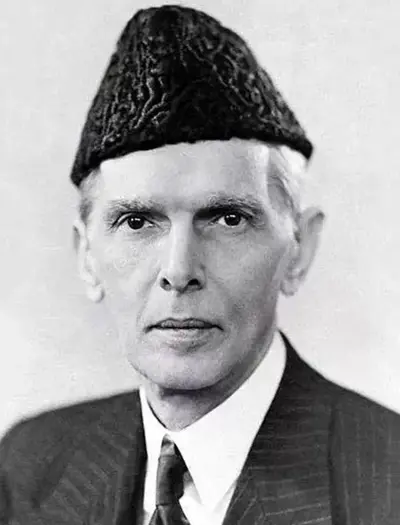
Muhammad Ali Jinnah was a barrister, politician and the founder of Pakistan. Jinnah served as the leader of the All-India Muslim League from 1913 until the inception of Pakistan on 14 August 1947, and then as the Dominion of Pakistan's first Governor-General until his death. He is revered in Pakistan as the Quaid-i-Azam ("Great Leader") and Baba-i-Qaum ("Father of the Nation"). His birthday is observed as a national holiday in Pakistan.
