David Ben-Gurion Quotes
We can no longer regard the UN Resolution of the 29th of November as having any moral force. After the UN failed to implement its own resolution, we regard the resolution of the 29th of November concerning Jerusalem to be null and void
The Resolution to which he referred was Security Council Resolution 181 which Internationalized Jerusalem. The Israeli’s had wanted it for their capital. The Arabs wanted it. Christians had claims on parts of it. So the UN declared it an International City. The Israelis grudgingly accepted the resolution, but the Arab Armies attacked the new state of Israel. They were repulsed from most of Israel but they did take Jerusalem. The UN chose not to implement its own resolution and the Arabs controlled Jerusalem thereafter until they again tried to invade Israel again. This time they lost badly and the Israelis took Jerusalem and established it as their capital and Jews could pray in Jerusalem for the first time since 1948. Unlike the Arabs who kept the Israelis and other Jews out of the city when they controlled it, the Israelis turned over control of the Islamic holy places to Muslims and allowed Muslims access to them. The status of Jerusalem was still contested in the early 21st century.
David Ben Gurion, 1886-1973, First Prime Minister of Israel, Declaration to the Israeli Knesset (Parliament), December 3, 1949
Sourced by: Eigen's Political and Historical Quotations

Jerusalem has been disputed by the Israelis and the Arab nations surrounding the city. Both want it as their capital, and both have historic and religious claims on it. When Jerusalem was under Arab control. However no Jew was allowed in the City, even to pray at the holiest of Jewish places, the Western Wall. When Israil gained control, there has been not only free access for Muslims, but they gave the Muslims control over the Temple Mount--holy to both religions. So for Rabin, if Israell does not control the city, Jews will not have access as has been shown by recent history, and the United Nations has deminstrated so often, they will not use force to maintain their committments to protect people or assure access to areas.

The Arab World is made up of many small states who usually vote as a bloc. In addition, most of the other Islamic nations vote with their Arab co-religionists. Since its founding Israel has developed rapidly while the Arab nations have not and some have regressed. Their governments are embarrassed by their lack of progress and blame Israel to mollify their citizens.


The Temple Mount in Jerusalem is the base on which the Great Jewish Temple was erected. The temple was destroyed by the Romans. Hundreds of years later the Muslims built a mosque which the Prophet Muhammud himself is believed to have transported to. One side of the Temple Mount is the Wailing Wall, the holiest place on Earth for Orthodox Jews. When the Arabs controlled Jerusalem, they would not allow any Jews to pray at the Wailing Wall. When the Israelis gained control of the holy city they were more reasonable. They ceded day to day control of the Temple Mount—the top and the Mosque—to the Muslims and since then Jews have prayed at the side of the Mount and Muslims on the top. However there has been some friction about the archeology of the interior of the Mount itself. And some Muslims resent the fact that Israel controls the security and access to one of their holiest Mosques, and that in the event of some transgression in the Mount, Israeli civil law controls and not Islamic religious law—Sharia. Some permanent agreement will have to be made if there is to be an overall peace.

The Arabs did not accept the UN boundaries and tried military force to obtain all or some of the Jewish territory. They failed and Israel pushed them back across the borders and further. Then the Arabs protested that the Jews are occupying land that was awarded to the Arabs in the UN partition. Ben Gurion argues that since the Arabs would not recognize the UN borders when they wanted to enlarge their territory, there was no Israeli obligation to honor those borders and Israel enlarged their territory. Since the formation of the state of Israel, this pattern has repeated many times: The Arabs refused to recognize the status quo borders, they initiate hostilities to obtain more land, fail, and end up losing more land, and complaining that Israel is not respecting the borders.

The UN peacekeepers have had a sorry record of protecting people from aggression, attacks and even genocide. In Sarajevo they stood by as the Serbs rounded up 7,000 male Muslims and marched them off to be executed right past the United Nations forces. And the UN was unable to stop the genocide in Rwanda. In the Middle East on several occasions, Arab armies have walked right through the United Nations peacekeepers and attacked Israeli civilians. So no one, lease of all the Israelis have any confidence that the United Nations can provide security in Jerusalem or anywhere else in the Middle East. The Israeli position was that when the Jordanians controlled the city, they did not allow Jews to their sacred places to pray or have access to the city. The UN could not prevent violence at all. No one else is willing, but since 1967 the Israelis have maintained the peace and security of the city while allowing the Arabs and other groups access to their places of worship.


When the United Nations partitioned Palestine into separate Jewish and Muslim states, the armies of all the Arab countries attacked the new nation which did not even have a formal Army. The Israelis were able to win the war.
His is one extremist view of Jerusalem. Most historians agree that both Jews and Arabs have lived in Jerusalem since recorded history. Extremists on both sides of the Arab Israeli debate have constructs which deny the existence of the other group. Sisalem is one. Both the Palestinians and Jews claim Jerusalem as their capital and both have reasonable historical claims, and both have shared the city for thousands of years.

This quotation is the basis of the Arab argument that the United Nations decided that the Palestinian refugees who left Israel upon its creation at the urging of some Arab leaders. Other’s opposing this point of view observe that only the Security Council’s resolutions are binding and the General Assembly resolutions have no weight in International Law. Further that the Arab Refugees do not want to “live at peace” as is required in the resolution. Numerous surveys demonstrate the desire of most of the Palestinian refugees to support efforts to expel the Jewish Israelis from Israel. The other barrier is that there are tens of thousands of Jews who were forcibly ejected from Arab countries for whom no country is offering a right of return. The irony of Resolution 194 is that it was opposed by every Arab country at the time.


The very day of Israel’s birth, 14 Arab Armies attacked a badly outnumbered group of citizens with no formal army and few weapons. The reason the Mufti called on Arabs to leave was to allow the Arab heavy armor and artillery to be used without endangering Arab civilians. The Jews however had no place to go and were fighting for their very lives. Surprising the entire world, they not only beat back all the Arab Armies but won additional strategic positions. The Arabs who stayed became Israeli citizens and there are almost ½ million of them today. Those that left, were rejected by the Arab nations who started the war (except Jordan) and asked them to leave could not be distinguished from those Arabs who, even after the Israeli victory vowed to attack again. That is the origin of the Arab refugees. Since the other Arab states except Jordan would not assist their fellow Arabs, the only solution seems to be a Palestinian State on the West Bank and Gaza, but for that to happen war and terrorism would have to end and Israel would have to be accepted.
A major issue amongst Israeli’s is to how they should relate to those hostile Islamic nations in their area who claim they are at war with Israel or the Jewish People. This position in effect says that the oratory of those Islamic groups that claim that they are in a war—a holy war even—should be taken at their word and treated as a wartime enemy and Israel should actively attempt to kill and destroy them.

This resolution has never been rescinded. Some Arab states have abandoned this resolution and negotiated peace and recognition such as Egypt. The majority of the Arab States did and do not want peace with Israel. They did and do not want to recognize Israel and they did and do not want to negotiate. But they often blame Israel for being intransigent in the peace process. Many Arabs want a peace treaty and want to negotiate but the extreme rejectionists generally dominate Arab politics.

A minority of Jewish Israelis do not recognize the United Nations 1949 partition boundaries of the land creating modern Israel. They believe that God gave all the land to the Jewish people—as described in the Bible. Therefore, to them, the West Bank is a part of Israel. No Israeli government has ever maintained that position. However some governments which depend on settler and ultra-Orthodox support do not publicly disavow the position. Palestinians, look with alarm, on this view and the constant attempts at encroachment on West Bank land that the settlers attempt. Like the extremist Palestinians who want to sabotage any two-state solution, there is a minority of Israelis who do the same. These two groups made the peace process very difficult as their adherents are not only very passionate about their views, but have political influence out of proportion to their relatively small number of voters.
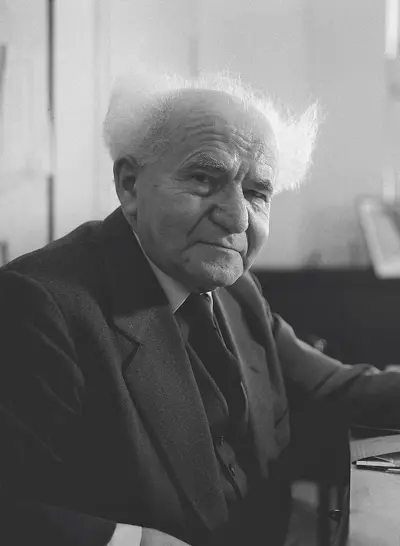
David Ben-Gurion, born David Grün, was the primary founder of the State of Israel and the first Prime Minister of Israel. Ben-Gurion's passion for Zionism, which began early in life, led him to become a major Zionist leader and Executive Head of the World Zionist Organization in 1946. As head of the Jewish Agency from 1935, and later president of the Jewish Agency Executive, he was the de facto leader of the Jewish community in Palestine, and largely led its struggle for an independent Jewish state in Mandatory Palestine. On 14 May 1948, he formally proclaimed the establishment of the State of Israel, and was the first to sign the Israeli Declaration of Independence, which he had helped to write. Ben-Gurion led Israel during the 1948 Arab–Israeli War, and united the various Jewish militias into the Israel Defense Forces (IDF). Subsequently, he became known as "Israel's founding father".; David Ben-Gurion was the primary founder of the State of Israel and the first Prime Minister of Israel.
