Yitzhak Rabin Quotes
If they told us that peace is the price of giving up on a united Jerusalem under Israeli sovereignty, my reply would be “Let's do without peace.”
Jerusalem has been disputed by the Israelis and the Arab nations surrounding the city. Both want it as their capital, and both have historic and religious claims on it. When Jerusalem was under Arab control. However no Jew was allowed in the City, even to pray at the holiest of Jewish places, the Western Wall. When Israil gained control, there has been not only free access for Muslims, but they gave the Muslims control over the Temple Mount--holy to both religions. So for Rabin, if Israell does not control the city, Jews will not have access as has been shown by recent history, and the United Nations has deminstrated so often, they will not use force to maintain their committments to protect people or assure access to areas.
Yitzak Rabin, 1922-1995, Israeli Prime Minister (Labor), General & Israeli Defense Minister, Nobel Peace Laureate, Remark to a group of Tel Aviv schoolchildren on June 27, 1995
Sourced by: Eigen's Political and Historical Quotations

The Temple Mount in Jerusalem is the base on which the Great Jewish Temple was erected. The temple was destroyed by the Romans. Hundreds of years later the Muslims built a mosque which the Prophet Muhammud himself is believed to have transported to. One side of the Temple Mount is the Wailing Wall, the holiest place on Earth for Orthodox Jews. When the Arabs controlled Jerusalem, they would not allow any Jews to pray at the Wailing Wall. When the Israelis gained control of the holy city they were more reasonable. They ceded day to day control of the Temple Mount—the top and the Mosque—to the Muslims and since then Jews have prayed at the side of the Mount and Muslims on the top. However there has been some friction about the archeology of the interior of the Mount itself. And some Muslims resent the fact that Israel controls the security and access to one of their holiest Mosques, and that in the event of some transgression in the Mount, Israeli civil law controls and not Islamic religious law—Sharia. Some permanent agreement will have to be made if there is to be an overall peace.


This was an interview with Reuters News Agency in English. Arab leaders often make English Statements to the Western Press which are completely contradictory to what they say to their Arab constituents and followers. In this case he seems to acknowledge that Hamas and he do not deny the right of Israel to exist and accepts that nation per se. Yet at the same time Meshaal has never made this statement in Arabic and has made no gesture to change the Hamas Charter which calls for the destruction and elimination of Israel or to criticize the Hamas other leaders and followers who constantly call for “Death to Israel” and the destruction of the Jewish state. See {585395} for an eloquent statement of the practice of Arab leaders and politicians.


A major issue amongst Israeli’s is to how they should relate to those hostile Islamic nations in their area who claim they are at war with Israel or the Jewish People. This position in effect says that the oratory of those Islamic groups that claim that they are in a war—a holy war even—should be taken at their word and treated as a wartime enemy and Israel should actively attempt to kill and destroy them.


This resolution has never been rescinded. Some Arab states have abandoned this resolution and negotiated peace and recognition such as Egypt. The majority of the Arab States did and do not want peace with Israel. They did and do not want to recognize Israel and they did and do not want to negotiate. But they often blame Israel for being intransigent in the peace process. Many Arabs want a peace treaty and want to negotiate but the extreme rejectionists generally dominate Arab politics.

The Palestinians were split between supporters of Hamas and Fatah. The former was a terrorist organization which refused to recognize the right of Israel to exist and whose charter called for the killing of all Jews. The latter, accepted the right of Israel to exist and was committed to peace and coexistence with the Jewish state. They had fought a civil war and Hamas controlled Gaza with well over 1 million people which they seized for force and killed of forced out Fatah Representatives. Fatah was the elected ruling party of the West Bank, the larger and more populous of the Palestinian territories. There was little chance of any peace given that split. However, Israel which had undergone over 7000 rockets fired upon them by Hamas, stated that they refused to negotiate with the Palestinians as long as the Hamas terrorists were a part of the control of the potential Palestinian state. They would only discuss a 2 state solution if Hamas agreed that they accepted the right of Israel to exist in their general territory as a Jewish State, Hamas would accept and follow previous agreements made with the Palestinians, and Hamas would give up terrorism and the objective of killing Jews. So either Hamas would have to change its policies or Israel would negotiate with an organization that claimed it would never accept the existence of that country as a Jewish state. Al-Masri thought that the agreement he had mediated, was a necessary first step and was constructive for all the parties.

This is an example of a diplomatic leader losing control of herself and addressing a foreign dignitary in most undiplomatic language. The basic accusation was however quite justified. The Palestinians were preoccupied with many symbols of dignity and respect while ignoring economic development, technology, health and standard of living that could have been obtained by a compromise with Israel to create a Palestinian state.

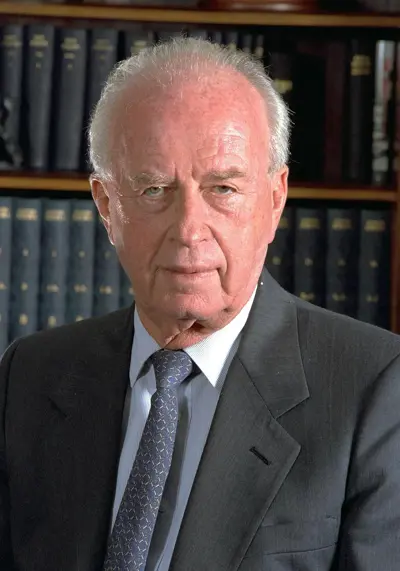
Yitzhak Rabin was an Israeli politician, statesman and general. He was the fifth Prime Minister of Israel, serving two terms in office, 1974–77, and from 1992 until his assassination in 1995.
