John C. Calhoun Quotes
War, in our country, ought never to be resorted to but when it is clearly justifiable and necessary; so much so as not to require the aid of logic to convince our understanding nor the ardour of eloquence to inflame our passions. There are many reasons why this country should never resort to it but for causes the most urgent and necessary.
Calhoun, John C. The Works of John C. Calhoun. Edited by Richard K. Crallé, vol. 2, D. Appleton and Company, 1853, p. 1.


At a requiem for those who died on the battleship Maine, Gibbons criticized war mongering yellow journals. This was a very courageous statement to have made. The Hearst newspaper had fired up the American appetite for revenge and almost all the politicians were advocating war. At the time anti-Catholicism in America was extensive and Catholics were always being accused of not being patriotic Americans and more loyal to the Vatican than to the United States.

At the time of this speech virtually the entire world believed that. However world attitude changed markedly after the administration of George W. Bush and the United States invasion of Afghanistan after September 11 and the Iraq War which was for regime change.


The highest court in New York. Kent did not originate this concept. He was stating an age old principle of law: Posse vicinum impediri, ne in suo solo, sine alia causa suaque evidenti utilitate, munimentum nobis propinquum extruat, aut aliud quid faciat, unde justa formido periculi oriatur.


Clinton was one of the leaders of the anti-war movement of the day. He even ran for President on the new “Peace Party.” New England, New York and many people in the Atlantic states thought the war of 1812 absurd. In reality, while the law was good for American morale and national pride, the casualties we suffered and the cost was far greater than what we were losing in our dispute with England. In actuality, France (under Napoleon) was offending America and seizing our shipping more than England. Note that Clinton was advocating negotiation even AFTER we would be attacked. This is in a way the complete opposite of the George W. Bush doctrine of preemption—attacking a hostile state BEFORE it has attacked us so as to prevent the casualties of an attack. The Bush doctrine was a great blunder in its only implementation—Iraq did NOT have the weapons of mass destruction that Bush and his administration claimed they had to justify the preemptive war.


Actually, the two world wars were wars of necessity. The Korean War and the Vietnam war are considered by many as wars of choice. But most of our military incursions—the Mexican War, the Spanish American War, Grenada, the Serbian War, Hati incursions and many others were wars of choice for which there were often very good reasons. However, we have to go to war when America is existentially threatened. In that sense, the Iraq War which Kerry was primarily addressing, could be interpreted either way. If it was really true thread. That is what caused most members of Congress to vote to approve the war. However, when that turned out to have been untrue, and it was suspected that the weapons of mass destruction was a deliberate ruse by some.


14 years after this statesmanlike speech, Davis flip flopped on this principle and became a firebrand and agitator and hawk for secession and war. It was the Southern upper class that controlled the politics of the South and were the ones who would suffer the greatest economic loss if the Union had continued in the direction of refusing to return runaway slaves and other abolitionist activity. Although many Southerners volunteered to fight for the confederacy, there were not enough and Davis, who in earlier years would not war unless there was genuine demand of the people, for the Civil War, the South had to resort to conscription. The North did as well.


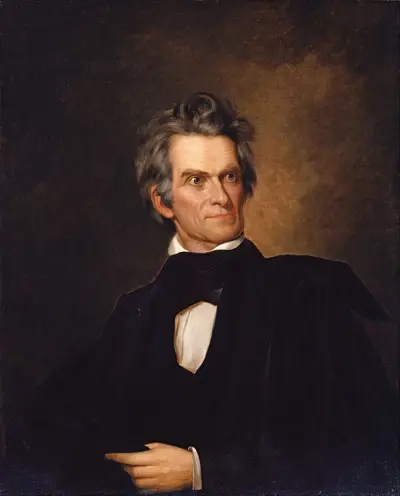
John Caldwell Calhoun was an American politician and political theorist from South Carolina who held many important positions including being the seventh vice president of the United States from 1825 to 1832, while adamantly defending slavery and protecting the interests of the white South when its residents were outnumbered by Northerners. He began his political career as a nationalist, modernizer, and proponent of a strong national government and protective tariffs. In the late 1820s, his views changed radically, and he became a leading proponent of states' rights, limited government, nullification, and opposition to high tariffs. He saw Northern acceptance of those policies as a condition of the South remaining in the Union. His beliefs and warnings heavily influenced the South's secession from the Union in 1860–1861.
