Lyndon B. Johnson Quotes
Vietnam is getting worse every day. It’s like being in an airplane and having to choose between crashing the plane or jumping out. I do not have a parachute.
Lyndon Baines Johnson, 1908-1973, 36th President of the United States (Democrat, TX), Telephone Conversation with his Wife, July 1965
Sourced by: Eigen's Political and Historical Quotations

He had just digested his predecessor’s reports and briefings as well as key interviews with senior military officers. See {637677} for his predecessor’s statement in the previous White House meeting on the War.


The coalescing of Public Opinion against slavery in the North was punctuated by the election of Abraham Lincoln in the eyes of the supporters of slavery left them with no where to turn within the Union. Secession followed.


Goodnight had fought on the Confederate side. He got himself together and became a very large rancher.

See the Macnama telephone quotation when the Joint Chiefs of Staff wanted many more combat soldiers in Vietnam. Johnson felt he had no political choice.


Up to that time U. S. policy was to provide training and assistance to the South Vietnamese government and military, but not to attack the North. America had backed a corrupt and incompetent South Vietnamese government and Bundy and other policy makers were convinced that the North Vietnam would win, if the fighting and governing were solely left to the South Vietnamese. Johnson, who had resisted this policy for several weeks finally acceded. It was a major escalation of the Vietnam War.

The President told McNamara that if the administration does not send the troops the Generals want, they will be blamed for any military failures that occur. If they do send all the troops that the Joint Chiefs wanted, they would be going far beyond the limits that the Defense Secretary recommended and the President would have preferred. JBJ felt he really had no political choice. He authorized the wanted troops further escalating the war. See his special assistant’s question about that decision in {617151}.


The “surge” was the short term injection of a large number of American combat troops into Iraq when the Iraq War was going badly. President George W. Bush, who at the urging of Vice President Cheney and the neoconservatives had invaded Iraq and while the invasion went well the administration botched the so-called peace and America was in the midst of a Iraqi civil war. Bush went ahead with the surge despite the advice of the Joint Chiefs. What makes the quotation particularly interesting, beyond the fact that the senior military advice was ignored, was that the President had always campaigned on the principle that the President should listen to the senior American Military officials on military tactics and strategy. He like Franklin Roosevelt, Harry Truman, Dwight Eisenhower, John F. Kennedy, and other presidents found that the military leadership perspective was often very narrow and not even militarily infallible. The Iraq War turned in our favor after the surge albeit that there have been arguments since then as to whether or not the surge was the reason or was it due to other factors which occurred at the same time. Probably, all were factors.

He had just assumed his post 6 days earlier. At this point he did not have enough knowledge to favor or oppose the regime change, but he did realize that the decision was a serious one and there would be no turning back. Diem was a creature of the Central Intelligence Agency. An anti-Communist Christian in a Buddhist county, the CIA engineered his rise to power, created his political party, provided him with cash to bribe other Vietnamese politicians, and paid for all the propaganda so he would “win” the Presidential elections. However, he abused the Buddhists, was thoroughly corrupt and ran a corrupt administration, but worst of all from the American point of view, he was unable to motivate the South Vietnamese population to fight the Communists. He reached the point where he was more of a liability, and the Central Intelligence Agency engineered a coup d’etat to remove him from power and replace him with a President more to our liking. (See {634540}.)


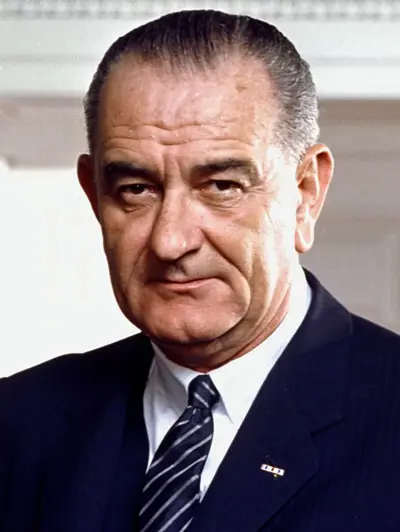
Lyndon Baines Johnson, often referred to by his initials LBJ, was the 36th president of the United States, in office from 1963 to 1969. He served as the 37th vice president from 1961 to 1963 and assumed the presidency following the assassination of President John F. Kennedy. A Democrat from Texas, Johnson was also a United States representative and later majority leader in the United States Senate. Johnson is one of only four people to have served, at various times, in all four federal elected positions.
