Bayard Rustin Quotes
Unless we get white people into the streets with Negroes for the march [on Washington], the fight will appear to be between white people and black and not between justice and injustice.
There was a large contingent of whites who showed up—many invited and expected and many who came on their own.
Bayard Rustin, 1912–1987, Civil rights activist, chief organizer of the 1963 March on Washington, and adviser to, A. Philip Randolph & Martin Luther King, Jr Statement to the Washington Post about the March on Washington, 1963
Sourced by: Eigen's Political and Historical Quotations

J. Edgar Hoover, the racist FBI Director, and the Chief of Police of the all white Washington DC Police Force, had made phone calls and sent memos to as many important people they could reach, warning that there was bound to be violence if 100,00 militant Blacks tried to march on Washington. There were twice that number planned for by Bayard Rustin, the man in charge of the March planning, but 250,000 showed up. There were very few incidents and no injuries and deaths as a result of some brilliant planning by Rustin and the cooperation of Attorney General Robert F. Kennedy—the President’s brother—with Rustin. However, the fear spread by Hoover and others caused the major league baseball games to be cancelled, liquor stores to be closed, stores and offices throughout the city were intimidated and closed. But it was one of the best organized and peaceful social/political demonstrations in history.

Lowery was one of the senior Black leaders in the civil rights movement of the late 1950s and early 1960s. In this interview, he was describing the atmosphere in Mobile, Alabama. Clergy of most faiths were active in the Civil Rights Movement in the South with the exception of the Roman Catholic Church which was very institutionally conservative. The Catholic leaders had a problem in that Catholics had been heavily discriminated against in early America and this prejudice was heaviest in the South in the 20th century. They feared that Catholic Activism against the status quo would create more problems for Catholics so they were not very helpful or supportive. This was NOT true for Catholics in general. Many individual Roman Catholics marched in the demonstrations, and some Catholic clergy from outside of the South came to the Southern protests and demonstrations. In the 20th century, the Catholic Church was divided between social activist reformers and in some cases revolutionists and the conservative wing of the Church who had supported the status quo.


Kennedy was initially very opposed to a civil rights march on Washington and seemed very annoyed to the Blacks in attended. But when faced with the reality of the fact that the March was going to take place and he could not prevent it, he turned around and did everything he could do to protect the marchers and enable the historic event.

The Quakers were in the forefront of not only the abolition of slavery but of the integration of the races.

Johnson rued that the Governor and other authorities of Alabama could not block or harass the Civil rights protesters.

Romney’s father, George W. Romney, was Governor of Michigan and lost in his attempt to be the Republican presidential candidate. He was a strong supporter of civil rights, but not only did Romney never see his father marching with King, there is no record that the elder Romney ever did march with King. He did march in a civil rights rally in Michigan but King was not present. The elder Romney was a strong supporter of civil rights however, and the son was trying to make the point that he came from a family where civil rights has always been important. This quotation became a cause célèbre in the 2007 Presidential primary campaign as critics gave this as an example of Romney’s disregard for the truth in his effort to be liked and gain support. Defenders claimed that this was a symbolic statement and an example of acceptable political hyperbole.

He had written this text on a newspaper when he was jailed in Birmingham for violating a court order not to demonstrate. A common tactic of the Southern segregationists was to have local segregationist judges issue injunctions against civil rights demonstrations on the grounds that they would promote violence. These were generally unconstitutional, but King and others were jailed until the legal appeal could even be heard.

At the time the Democratic Politicians of the South went to extremes from refusing to register Black voters to countenancing assault, torture and even murder of Blacks who organized voter registration. When the racists switched to the Republican party, is was Republican politicians who tried to make voter registration and voting more difficult for minorities, but the means and degree of these efforts were very mild compared to what is was when Rustin uttered this quotation.

She was one of the first prominent white southerners to denounce racial segregation. Also, she supported Martin Luther King’s protest organization in Montgomery long before most other whites.
This was of course in addition to their moral position as taught by their religions.
The March had begun in Selma with 600 marchers who were brutally beaten and harassed along the way. This brought clergy and lay people from the country over to join the protest march and when King gave the speech the marchers had swelled to 25,000.


The organization was one of the first organized to agitate against the slave trade. He had organized many of the intellectual leaders of France to join in this effort.

Throughout the Jim Crowe era of the South, the Southern whites were the poorest Americans with the exception of the Blacks, with few economic and cultural opportunities compared with the rest of the nation, the schools were the weakest of any area of the nation, the universities behind, and politically even whites had few choices with single party (Democratic Party) rule. While desegregation was fought tooth and nail by most white Southerners, it had the effect of elevating all phases of Southern life go that the gap between the South and the rest of the country diminished considerably. But the Blacks were also freed from the evil system and that was the “price” to the whites to which Baldwin referred.
This quotation illustrates one of the earliest major political dirty tricks. The pamphlet was published supposedly as a Republican campaign piece. The Democratic ploy was to turn votes from Abraham Lincoln to the Democratic candidate, George B. Mclellan. It also appears to be the first English usage of the word “miscegenation”. Lincoln was re-elected in spite of the Republicans being portrayed as radical race mixers.
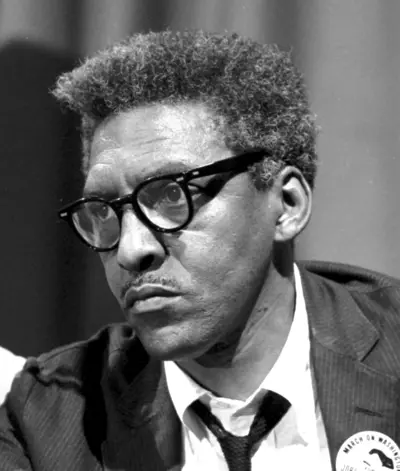
Bayard Rustin (March 17, 1912 – August 24, 1987) was an African American leader in social movements for civil rights, socialism, nonviolence, and gay rights.
