Joseph Stalin Quotes
Undoubtedly, our path is not of the easiest; but, just as undoubtedly, we are not to be frightened by difficulties. Paraphrasing from the well-known words of Luther, Russia might say: ‘Here I stand on the frontier between the old, capitalist world and the new, socialist world. Here on this frontier I unite the efforts of the proletarians of the West and of the peasantry of the East in order to shatter the old world. May the god of history be my aid!
Stalin, Joseph. Works. Vol. 6, Foreign Languages Publishing House, 1953, p. 419.


This is a very important historical, political quotation. The conservatives have since the Russian Revolution conflated socialism and communism. However, here in 1932 the leader of the American Socialist Party had already described the Communist Revolution in Russia as a failure of founding an acceptable modern state. Nonetheless, even into the 21st century many conservatives describe Thomas as a Communist. See {626692} for his distinction between Communism and Socialism. The difficulty of modern nation building was explained by Thomas and others but was really not accepted until the many attempts of the early 21st century, some supported by America like Iraq and Afghanistan and the Balkans and others like the “Arab Spring.” Then his early wisdom on this point became more appreciated.

This was the basic document issued after the Russian Revolution establishing the basic legal and economic structure of the new Soviet State.
This was the basic document issued after the Russian Revolution establishing the basic legal and economic structure of the new Soviet State.

Vladimir Lenin

The letter was widely published. There were few left wing intellectuals who would take Lenin on at the time but Gorter was one. The immediate quotation shredded a brochure that Lenin had produced for world wide communism where he was critical of other left wing movements.
The revolutionists had just captured the Winter Palace: Vladimir Lenin
Vladimir Lenin

This quotation illustrates White’s favorable view of Russia. Note his use of the “it works” phrase which he picked up from Stefens’ famous quote {634892}. At the time the Soviet Union had been perceived by many economists to have been a great economic improvement over Czarist Russia. And over all, Russia which in 1917 was an economic basket case, had become one of the stronger states in Europe although the Russian people paid a horrendous price. Most historians agree that White passed classified information to the Russians. He was accused of being a Communist, but there was never any evidence of that. Some people believe that he was a spy for the Russians and committed espionage, but others disagree observing that White was very much his own man and felt that much information that was classified never should have been. White substituted his own judgment, it is believed, about what could be given to the Russians for the security system. He was an admirer of what Russian socialism had accomplished economically, educationally and medically since the 1917 revolution deposing the Czar. Russia had been a valuable military ally, which had taken the brunt of both military and civilian casualties in WWII. White’s economics were certainly not Marxist but very much Keynesian. He was subpoenaed by the House Un-American Activities Committee where he was accused of being a Communist which he denied (see {634907}). He died of a heart attack 3 days later.

Vladimir Lenin


Vladimir Lenin. This is a very important historical quotations. It was made by Lenin soon after the 1917 Russian Revolution and surprisingly to most he declared that the exporting of the Communist Revolution was more important than the national interest of communist Russia. Many Western nations, including the U. S. sent troops to part of Russia on various pretexts and it appeared to many that the West was ganging up against Russian Communism and interfering with their internal affairs. However, in effect, the new Russian state, with the attitude expressed by this quotation, was declaring a type of revolutionary war on all the capitalist nations who saw this fledgling mess of a country as a potential threat. They were right.

Immediately after the Russian Revolution, the provisional government appointed him as Ambassador to the United States. However, the provisional government was supplanted when the Bolsheviks took over. Not enamored of Communism, he stayed in the United States with many other Russian refugees.

This is an example of what made the Cold War so difficult. The Italian Communists had great misgivings about the Russian version of Communism that tended to abuse human rights and try and control other countries. However, when the Russian Communists were under world attacks by the West, as with their incursion into Hungary, he urged that all the Communists stick together and defend the Russians even for policies that they thought wrong. On the West side, the same thing occurred. The United States tolerated and supported a number of terribly oppressive dictatorships that were virulently anti-Communist. Polarization was the international norm.


Alexander Dubcek, Communist leader of Czechoslovakia, had pushed reform so far that 5 Soviet armies invaded. Dubcek was brought to Russia where he tried to persuade the Russian premier that the invasion was contrary to the principles of socialism.
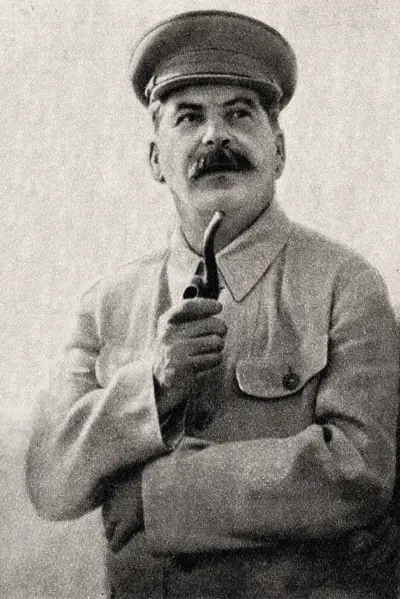
Joseph Vissarionovich Stalin was a Georgian revolutionary and the ruler of the Soviet Union from 1927 until 1953. He served as both General Secretary of the Communist Party of the Soviet Union (1922–1952) and Chairman of the Council of Ministers of the Soviet Union (1941–1953). Despite initially governing the country as part of a collective leadership, he ultimately consolidated power to become the Soviet Union's de facto dictator by the 1930s. A communist ideologically committed to the Leninist interpretation of Marxism, Stalin formalized these ideas as Marxism–Leninism while his own policies are known as Stalinism.
