Vladimir Lenin Quotes
It is not national interests we are upholding — we claim that the interests of socialism, the interests of world socialism, rank higher than national interests, higher than the interests of the state. We are defenders of the socialist fatherland.
Vladimir Lenin. This is a very important historical quotations. It was made by Lenin soon after the 1917 Russian Revolution and surprisingly to most he declared that the exporting of the Communist Revolution was more important than the national interest of communist Russia. Many Western nations, including the U. S. sent troops to part of Russia on various pretexts and it appeared to many that the West was ganging up against Russian Communism and interfering with their internal affairs. However, in effect, the new Russian state, with the attitude expressed by this quotation, was declaring a type of revolutionary war on all the capitalist nations who saw this fledgling mess of a country as a potential threat. They were right.
Nikolai Lenin, 1870-1924, Russian Communist Premier, Address to the Party Central Committee, May 14, 1918
Sourced by: Eigen's Political and Historical Quotations


The reason this is an important quotation is that since the end of WWII, most Americans have used the term “socialism” rather loosely. President Obama for example is often referred to as a socialist by his political enemies. Conservatives refer to Norway, Sweden and Denmark and other European nations as socialist states. But none of them would ever meet the definition of a socialist state of the major socialist state in history. After WWII, the Russians intimidated many of the Eastern European with force of arms and there were some other socialist states for a while but the all abandoned Soviet style Russian socialism, Ironically, the only state that the old Russian Communists would recognize in 2011 was Cuba. However, there are many who call themselves socialists who would never agree that the Soviet Union was remotely a socialist state—they see it as a Fascist dictatorship.


After the 1917 Russian Revolution many of the Western Countries sent troops to Russia where they aided the Whites against the Reds. When the Red Bolsheviks prevailed, there were many attempts to diplomatically and economically undermine the Communist government. This caused a unity among different Russian factions. Sforza urged leaving them alone and letting the Bolsheviks fail by their own ideology. Most Western nations and the United States did not agree with him.


At the Seventh World Congress of the Comintern in 1935 the new Popular Front policy was announced. To communist hard-liners and to the far left, the policy was an abandonment of the Marxist revolutionary line.


This was the basic document issued after the Russian Revolution establishing the basic legal and economic structure of the new Soviet State.


So often in America, citizens and government officials have made alliances or joined organizations under the theory that “the enemy of my enemy must be my friend.” It has almost always been a mistake ranging from joining the Communist Party in the 1930s to supporting the dictators or the Middle East, Asia, and South America. In the 1930s Fascism was growing and already on the march and neither America nor England—the leading democracies were not doing anything to combat the threat. America was emerging from the Great Depression, had a string Isolationist movement, and a small but influential group of Fascists and Hitler enthusiasts. Also, no one outside of Russia knew about the Stalin atrocities.


This is a very important historical, political quotation. The conservatives have since the Russian Revolution conflated socialism and communism. However, here in 1932 the leader of the American Socialist Party had already described the Communist Revolution in Russia as a failure of founding an acceptable modern state. Nonetheless, even into the 21st century many conservatives describe Thomas as a Communist. See {626692} for his distinction between Communism and Socialism. The difficulty of modern nation building was explained by Thomas and others but was really not accepted until the many attempts of the early 21st century, some supported by America like Iraq and Afghanistan and the Balkans and others like the “Arab Spring.” Then his early wisdom on this point became more appreciated.

The reason that this quotation is important is that most Americans from the 1920s on concerned with Marxism and communism in the United States, conflated Marxism with Anarchists as if Marxists were anarchists who were bent on violence. In reality, to most Marxists, anarchists were more their enemy than the capitalists. Stalin was then only 28 years old and the Russian revolution was 9 years in the future.


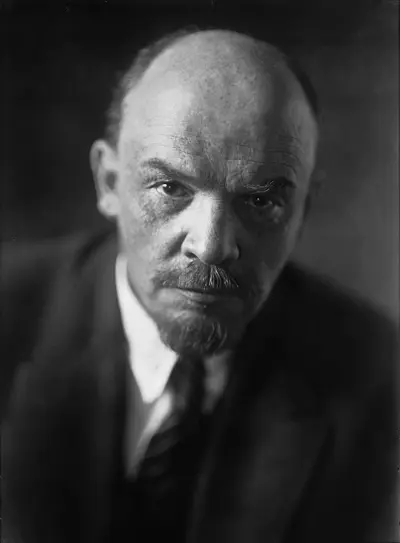
Vladimir Ilyich Ulyanov, better known by his alias Lenin, was a Russian revolutionary, politician, and political theorist. He served as the first and founding head of government of Soviet Russia from 1917 to 1924 and of the Soviet Union from 1922 to 1924. Under his administration, Russia, and later the Soviet Union, became a one-party socialist state governed by the Soviet Communist Party. A Marxist, he developed a variant of this communist ideology known as Leninism.
