Zbigniew Brzezinski Quotes
To put it in a terminology that harkens back to the more brutal age of ancient empires, the three grand imperatives of imperial geostrategy are to prevent collusion and maintain security dependence among the vassals, to keep tributaries pliant and protected, and to keep the barbarians from coming together.
Zbigniew Brzezinski, U. S. National Security Advisor, The Grand Chessboard, 1997
Sourced by: Eigen's Political and Historical Quotations

This is the kind of threat that was used by Germany before the First World War. It worked with Turkey, but King Albert realized that being an “ally” of Germany meant losing independence anyway. Belgium would not join Germany, so the Germans invaded Belgium in 1914. Belgians fought with the allies and at the end of WWI, they were able to rebuild their independent state and thrive until they were again invaded by Germany in WWII. Turkey, in contrast, lost their entire empire, as a result of their fighting as German allies in WWI.


Vietnam and Thailand were both major powers both militarily and economically. Cambodia, adjacent to both was poor and weak. The two powers wanted little in Cambodia, but wanted to keep the other out. Both had military incursions into Cambodia, and thought that the cost of permanent occupation or annexation of the backward Cambodian Khmer areas was not worth the expense. However, Cambodia could do nothing which would offend either power.

The United States and England maintained officially that their stance was moral and ethical. And it was for most Americans and Britons. However, there were some, whose motivation was economically self-serving as this quotation suggests. The less control Japan had over China, the more other countries could freely trade with China.


The issue of unilateral or multilateral foreign policy efforts faced America after WWII.

Patton was a great fighting general, but a disaster at civilian and public relations. At a time when the American and British governments were arguing that their involvement in world war two was for the benefit and protection of mankind, Patton made public statements like this one.


Referring to the proposal to Annex Hawaii in 1887:


Johansson is describing the origin of the word “hegemony.” During the 5th Century B.C. Athens and their allies formed the Delian League to combat the Persian Empire. Athens, as the most powerful city-state in Ancient Greece, controlled the alliance and the League soon turned into the Athenian “empire” or “hegemony.”

At the end of WWII there was much tension between Russia and the Anglo-American alliance. This plan was developed but never implemented. See {613195} for Prime Minister Winston Churchill’s description of the invasion idea.

There are many who disagree with Say’s claim that the ancient system of colonization produced more friends then the system was at the beginning f the 19th century. Alexander the Great may have been the only large conqueror in world history where the conquered people thought they were better off than before. Certainly the Romans did not make friends, and the French Normans who conquered England were never considered “friends” by the Saxons.


De Gaulle tended to see world affairs in terms of extreme, simplistic, and dramatic alternatives when reality is much more complex the truth was turned out to be for England a much more favorable outcome without either of these extremes.

A few months later, that is exactly what Germany did. She was hoping that England would not enter the war despite her treaty obligations, but she was willing to risk the possibility. The Czar had a strong espionage and intelligence service active in Germany, but, like so many other intelligence failures, the intelligence operatives and analysts had military and economic facts but had little understanding of the German culture which propelled Germany to what to most other cultures was “irrational policy making.” People and nations often engage in irrational activities, even against their own self-interest.

After the economic & power collapse of the Soviet Union, the United States was the only remaining superpower. Givern Russia's diminshed capability and many Americans still carrying resentments about the Cold War, America's foreign policy and diplomacy did not treat Russia as if they were a very important power in the world. Puten greatly resented the fact that Russia was no longer considered or treated like a world power, Russia had a nuclear arsenal and a total delivery system what was in the same destructive potential class as the United States. There were many Russiabs who had similar resentments and Putin sert out to adopt policieis and practices that would force the United States and the other nations to consider them with more dignity, respect and consdideration. This was a typical statement of the period when he was "stoking the fires of Russian resentment.


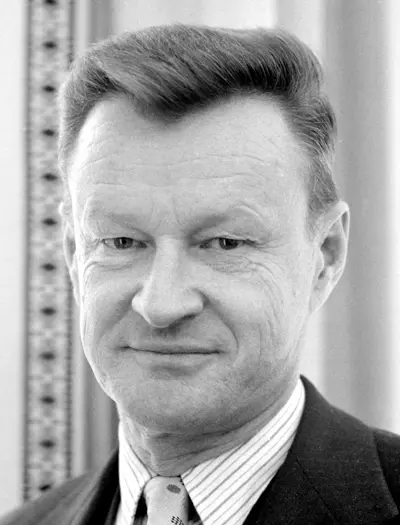
Zbigniew Kazimierz Brzezinski was a Polish-American diplomat and political scientist. He served as a counselor to President Lyndon B. Johnson from 1966 to 1968 and was President Jimmy Carter's National Security Advisor from 1977 to 1981. As a scholar, Brzezinski belonged to the realist school of international relations, standing in the geopolitical tradition of Halford Mackinder and Nicholas J. Spykman. Brzezinski was the primary organizer of The Trilateral Commission.
