Andrew Fletcher Quotes
When our kings succeeded to the crown of England, the ministers of that nation took a short way to ruin us … All of our affairs, since the union of crowns, have been managed by the advice of English ministers, and the principle offices of the kingdom filled with such men as the court of England would be subservient to their designs.
Andrew Fletcher, 1653-*, Scottish Member of Parliament and Soldier, c. 1699, xx
Sourced by: Eigen's Political and Historical Quotations


There are many who disagree with Say’s claim that the ancient system of colonization produced more friends then the system was at the beginning f the 19th century. Alexander the Great may have been the only large conqueror in world history where the conquered people thought they were better off than before. Certainly the Romans did not make friends, and the French Normans who conquered England were never considered “friends” by the Saxons.


"Imperium" is a Latin word which, in a broad sense, translates roughly as 'power to command'. In ancient Rome, different kinds of power or authority were distinguished by different terms "Imperium" referred to the sovereignty of the state over the individual—Wikipedia. The Consul was a wonderful diplomat. He had no respect for the South not only because they were fighting to maintain slavery, but also he found most of their diplomats and officials very incompetent. He found it hard to participate in all the Confederate ceremonies as he was their exhibit number one that they had International Recognition and they "exhibited him frequently. Despite this he was charming and never argumentative about slavery or other political positions that he loathed. As a matter of fact, the Southern Diplomats regarded him as a man sympathetic to the South with an understanding of their point of view. As a result he gained a huge amount of intelligence which he regularly dispatched back to London. England was neutral {35520} in the Civil War, but England did not recognize the Confederacy as a nation, else they would have sent an ambassador. The Southern politicians worked hard to get him to carry their message that if they would be recognized, they would grant England many favorable trade advantages as the English textile industry really wanted Southern cotton. While apparently sympathetic to the Southern cause, his reports contained all the negative information about the South and counseled against recognition just as the English Ambassador in Washington did—see {583131}.

When the British first colonized South Africa, the area they used was not inhabited or very sparcely so. However, some Black tribes (including the Zulus) were moving from the north and themselves were colonizing or annexing the sparcely populated areas to their kingdom. The British were most interested in Trading so did not have large land asperations. The Dutch white Boer Africanners, in contrast, wanted to farm the lands and use the range for their cattle. They wanted the land. The English policy was that there would be friendly relations with the Black tribes surrounding their Cape Colony and no one should take their land. However the Boers started attacking the Black areas and seizing their farms and villages. At first, the English assumed that the Blacks would easily be able to ward off the invasion as the Afrikanners had no professional troops like the British. However, the neighboring native tribes were not very warlike or good fighters. They were being overrun by the Zulus coming from the North and the Boers from the South. The British Government had a real problem in that they would have to have British soldiers fight the white Afrikanners if they wanted to stop the illegal white invasions. This was the root of the Boer War where the British would be fully at war with the Africanners.
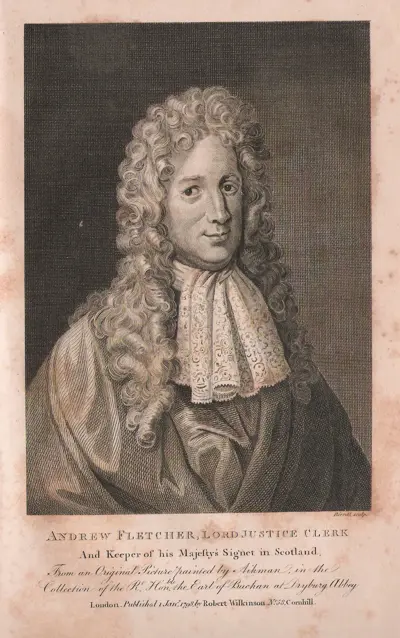
Andrew Fletcher of Saltoun was a Scottish writer and politician, remembered as an advocate for the non-incorporation of Scotland, and an opponent of the 1707 Act of Union between Scotland and England. Fletcher became an exile in 1683 after being accused of promoting insurrection. He was appointed the cavalry commander of the Monmouth Rebellion, but shortly after landing in England he killed another leading figure. He again went into exile, this time as a fugitive and with his estates forfeit. He returned with William of Orange, becoming Commissioner of the old Parliament of Scotland.
