John C. Calhoun Quotes
To maintain the ascendancy of the Constitution over the lawmaking majority is the great and essential point on which the success of the [American] system must depend; unless that ascendancy can be preserved, the necessary consequence must be that the laws will supersede the Constitution; and, finally, the will of the Executive, by influence of its patronage, will supersede the laws . . .
Calhoun, John C. "Speech on the Appointing and Removing Power." 13 Feb. 1835. The Works of John C. Calhoun, edited by Richard K. Crallé, vol. 2, D. Appleton and Company, 1853, p. 463.

One of the conundrums of our constitutional system is who has the last word as to what the Constitution means. Essentially it is the judicial branch headed by the Supreme Court. But there are those who believe that the current popular majority should have a say in what is or is not constitutional. If so the legislative branch should have the last word. Still others say that the President is the only person elected by ALL the people, so his opinion most reflects the will of the public. And then there are most who argue that the Constitutional system was created just to avoid the power of currently popular majorities, and the courts should decide based on the Constitution itself. So the statement has very little meaning except that Phillips thinks that the courts have too much power. Whoever gets to decide what is or is not Constitutional will be accused of being “over” the Constitution by those who don’t like the decisions. In our system, that is the courts.


The view that the Supreme Court was the final arbiter of constitutional controversies was not held in early America.


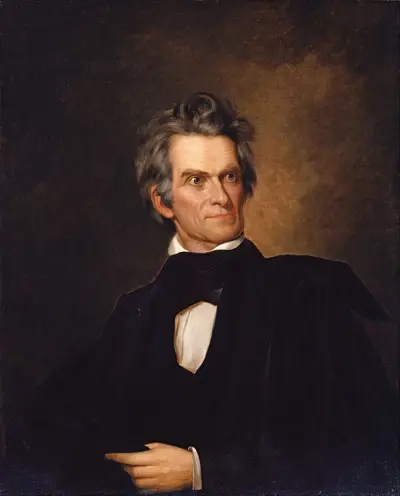
John Caldwell Calhoun was an American politician and political theorist from South Carolina who held many important positions including being the seventh vice president of the United States from 1825 to 1832, while adamantly defending slavery and protecting the interests of the white South when its residents were outnumbered by Northerners. He began his political career as a nationalist, modernizer, and proponent of a strong national government and protective tariffs. In the late 1820s, his views changed radically, and he became a leading proponent of states' rights, limited government, nullification, and opposition to high tariffs. He saw Northern acceptance of those policies as a condition of the South remaining in the Union. His beliefs and warnings heavily influenced the South's secession from the Union in 1860–1861.
