Adam Smith Quotes
To give the monopoly of the home-market to the produce of domestic industry, in any particular art or manufacture, is in some measure to direct private people in what manner they ought to employ their capitals, and must, in almost all cases, be either a useless or a hurtful regulation.
Adam Smith, 1723-1790, Scottish Political Economist, The Wealth of Nations, 1776
Sourced by: Eigen's Political and Historical Quotations


It is interesting that the first national women’s political party was a strong advocate of protectionism and saw free trade as an unfair hurdle for mostly male workers. At the time, the Republicans were staunch protectionists, and the Democrats, the free traders thus illustrating that the major parties continuously flip-flop on major issues.


Draft language is sometimes attributed to Senator George F. Hoar.

This same argument was used before and since to justify protecting domestic manufacturing from foreign competition until it can mature sufficiently to compete in a global economy. One difficulty occurs if protective tariffs are imposed for this reason. The manufacturers protected never seem to reach the point where they can compete without the subsidy.


The U. S. was very protectionist in its early history. Grant overestimated the time that it would take for us to change by about 100 years.


Turgot was one of the most advanced economic thinkers in Europe and realized, even before most of the Americans, that by freeing itself England, that the Americans would be forced to become free traders and that in turn would make America a major Economic power despite the fact that American economic policy over the years vacillated between protectionism and free trade.


In England at the time, the liberals were for free trade and the conservatives against. In both England and America both liberals and conservatives have flip flopped their roles in foreign trade several times. Free trade is a two edged sword; it aids domestic growth, employment and prosperity in some cases and hurts them on others. And there are always winners and losers for each example of free trade within any country. The result is no long term commitment and much flip flopping.

Conservatives generally do not have a problem with the businesses of the country exercising a great deal of control over the government, but the left wing usually does. However, when it is multinational corporations that pressure the government, then nationalist conservatives are distressed and join with the left lest “foreigners” control things rather than their own rich people.


Shortly thereafter, India started to reduce the protectionism.
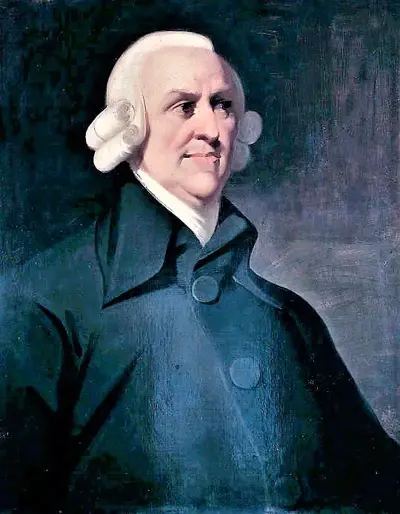
Adam Smith FRSA was a Scottish economist, philosopher as well as a moral philosopher, a pioneer of political economy, and a key figure during the Scottish Enlightenment, also known as ''The Father of Economics'' or ''The Father of Capitalism''. Smith wrote two classic works, The Theory of Moral Sentiments (1759) and An Inquiry into the Nature and Causes of the Wealth of Nations (1776). The latter, often abbreviated as The Wealth of Nations, is considered his magnum opus and the first modern work of economics. In his work, Adam Smith introduced his theory of absolute advantage.
