Adam Smith Quotes
To hinder, besides, the farmer from selling his goods at all times to the best market, is evidently to sacrifice the ordinary laws of justice to an idea of public utility, to a sort of reasons of state; an act of legislative authority which ought to be exercised only, which can be pardoned only in cases of the most urgent necessity.
Adam Smith, 1723-1790, Scottish Political Economist, The Wealth of Nations, 1776
Sourced by: Eigen's Political and Historical Quotations

To the modern reader utterances such as this from a Conservative Prime Minister seem astounding. However, the Great Depression existed in Canada as well as the United States, and Franklin Delano Roosevelt was not the only world leader who would reach the conclusion that business and capitalism must be profoundly regulated and the system changed if it was to be saved.


This is a very interesting quotation in that right wing parties are usually opposed to any kind of Government ownership and control of business and industry. However, Fascist parties have usually wanted to commandeer business and industry for the central purposes of the dictatorial state. The French National Front Party had its roots in the WWII French Vichy Government—which was allied with the Nazis to bring Fascism and racism to France.


Some economic conservatives see little or no role for government. For many of them, in a free market there is no role for government. This quotation, from one of the economic heroes of the conservatives, shows that he not only saw a role for government, but believed that government was essential to the operation of a free market.


Hoover was the Food Administrator at that time. Although he gave lip service to the free market economy concept, he was proposing government price controls and rationing. When the free market was not functioning, at this time in his career, he was willing to use government controls and regulation. By the end of 1918 over 250,000 food-handling corporations, firms, and individuals were under Food Administration licenses. Meat, fish, poultry, eggs, butter, milk, potatoes, fresh and dried vegetables, and fruits, canned goods, the coarse grains and rice, vegetable oils, coffee, and such various commodities accessory to food-handling, as ice, ammonia (for ice-making), arsenic (for insecticides), jute bags, sisal, etc., were under direct control. Ironically, later when he was President and faced with the Great Depression, he had become much more rigid and would not “interfere” with the free, private market and use government to solve the national problems. It was Franklin Delano Roosevelt who did that after Hoover would not. At the time he gave this speech, Hoover was not very political and was more of a technocrat. It may have been that by the time he became President he was intellectually and politically locked in to Republican Party conservative economic ideology.


Professor Epstein is a libertarian free market economist who advocates patience even if there are clear problems like corruption, unsafe working conditions, and the like. This view holds that the free market will sort itself out more effectively than the government will be able to do. Others, disagree.

See {642189} where Sherman explained some of the reasons for the law.


Brandeis was U. S. Supreme Court Justice Louis D. Brandeis, 1856-1941, who wrote that competition would control prices if only healthy competition could be maintained—the problem was resolved by both increasing competition and much more stringent regulation of corporations.

Hoover, a brilliant administrator before his presidency, was so ideological about the role of government that when the Great Depression came, he was unwilling to use government directly to cope with the new problems. He was turned out of office in favor of FDR and the New Deal which the voters ratified 4 times. Hoover was embarrassed by the New Deal successes and lashed out with many insults. In this case, he called the New Deal “fascist”. See {629055} for another quote where he labels the New Deal communistic. Ironically, Hoover is rated by most historians as one of the least effective Presidents in American history while Roosevelt is always rated among the top 3 presidents.


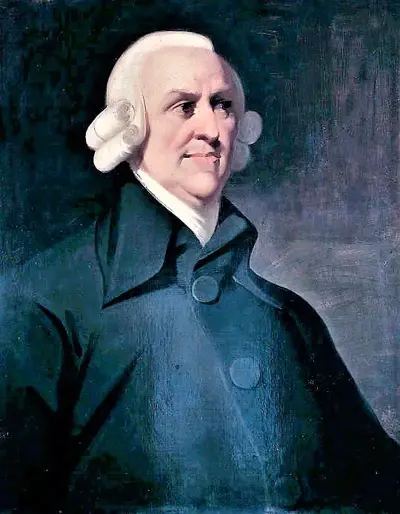
Adam Smith FRSA was a Scottish economist, philosopher as well as a moral philosopher, a pioneer of political economy, and a key figure during the Scottish Enlightenment, also known as ''The Father of Economics'' or ''The Father of Capitalism''. Smith wrote two classic works, The Theory of Moral Sentiments (1759) and An Inquiry into the Nature and Causes of the Wealth of Nations (1776). The latter, often abbreviated as The Wealth of Nations, is considered his magnum opus and the first modern work of economics. In his work, Adam Smith introduced his theory of absolute advantage.
