Ludwig von Mises Quotes
Every restriction of trade creates vested interests that are from then onward opposed to its removal.
Ludwig von Mises, 1881-1973, Austrian Economist & Political Philosopher, The Theory of Money and Credit, 1912
Sourced by: Eigen's Political and Historical Quotations

She was then the European Commissioner for Competition.


The President and his new appointee were half joking but many of the large corporations were attacking the new department and its head frequently. The extreme conservatives used the technique of personally discrediting the head of the agency to discredit the agency and its activities. The President himself was so popular that they did not dare attack him.

This criticism of business has been made ever since by many opposed to protectionism, corporate welfare, subsidies, and bailouts. Yet they get bigger each decade.

The “regulation” to which Franklin objected was not the type of regulation we have today. It was generally limited to the granting of monopolies to individuals or their companies if they would institute a service that was perceived as beneficial by the public as a whole. For example, a company might build steamboats and provide regular service across a river or along it. The company would argue that the initial cost and investment is so great, that they are entitled to a period of protection so that they can be sure of getting their investment back. In most cases, they would have made the investment, monopoly or not, and in many cases the public officials are unsophisticated and make a bad deal; in others there was (and is) outright corruption. Countries like Norway, have been so burned by the problem Franklin observed, that they try to avoid even government monopolies of service. They for example, have private and public light rail commuter lines which continuously compete against each other.


In addition the companies that are being protected suffer by not getting competitive and not utilizing the most modern and most efficient techniques. Even construction workers are hurt as protected companies do not modernize their facilities as often and build new plants.


See {642189} where Sherman explained some of the reasons for the law.


While this statement seems totally absurd to us today, at the time most politicians and judges believed it. Only the left wingers and the populists opposed the doctrine as well as most business owners who knew the truth but of course most preferred the have their own monopoly. One of the reasons the large American corporations did not want Jewish and Chinese immigrants is that those cultures supported highly competitive businesses and might give consumers a better deal or worse, their culture would argue for less monopoly and more competition. For more than half a century AT&T was given a monopoly over almost all telephone service in the United States. Finally the Federal Courts saw through the company propaganda, and ordered AT&T broken up. The “Baby Bells” have persuaded most state legislatures and regulatory bodies of this same argument, and almost every community of the United States has a monopoly on local wired local telephone service. The same is true about water and electricity and a great deal of American transportation. Every major company strives for as much of a monopolistic position the government will allow; some are overt like the electrical companies. Others are more subtle and use copyright and patents to be sure that there is no price or service competition. Fortunately, the high tech industry is to technologically competitive that prices have been have been going down constantly not like telephone and Internet connectivity, entertainment, education, and professional services.


He and his brother were the largest political contributors in the United States, so they had enormous influence on Republicans (they only made political contributions to conservative organizations).

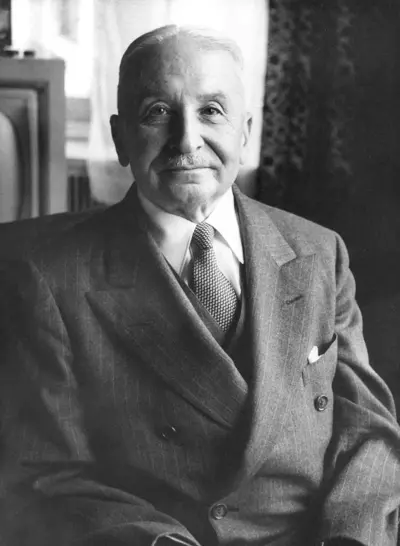
Ludwig Heinrich Edler von Mises was an Austrian School economist, historian, logician and sociologist. Mises wrote and lectured extensively on the societal contributions of classical liberalism. He is best known for his work on praxeology, a study of human choice and action.
