Milton Friedman Quotes
With some notable exceptions, businessmen favor free enterprise in general but are opposed to it when it comes to themselves.
Milton Friedman, 1912-2006, Nobel Laureate in Economics, Lecture "The Suicidal Impulse of the Business Community", 1983
Sourced by: Eigen's Political and Historical Quotations


Here, an officer of a large corporation (Pittsburgh Plate Glass) makes the classic argument of large corporations about the anti-trust laws which prevent them from using their economic power to crush competition. The claim that the large corporations are at a disadvantage and handicapped in competing with small companies is easily refuted by the bankruptcy rate of small businesses which is large, and that of large corporations which is very small, and that of major monopolies which is virtually zero.


This volume roughly is to Islam what the Gospels are to Christianity. To most Muslims The Sunnah is a collection of holy material on the life of Mohammed. It is not of the force or importance as the Koran, but it is revered.

Most companies in a capitalistic system compete mightily to obtain monopolistic positions so they can avoid capitalistic competition thereafter.


See Oliver Stone {625339} for a modern, popular culture, icon of this idea. Several years after this interview, Black, with business interests in several countries, was convicted and served a jail sentence in the United States for fraud. His greed got the best of him.

Most Americans agreed with this policy upon which Cleveland had run, but it was not favored by the companies that had been benefitting from monopolies, protective tariffs, corporate subsidies and corporate welfare, and government largess. Ironically, at the time, large American business was generally opposed to free trade and were supported by the Republican Party. The Democrats wanted free trade—just the opposite of the beginning of the 21st century.

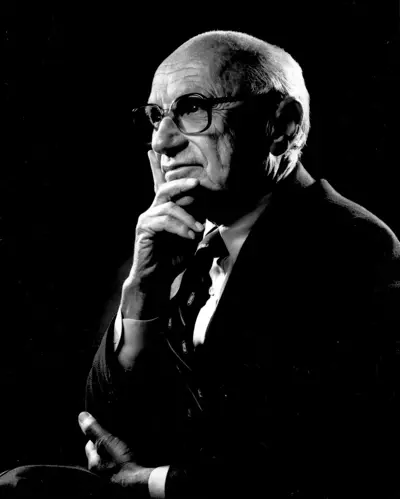
Milton Friedman was an American economist and statistician who received the 1976 Nobel Memorial Prize in Economic Sciences for his research on consumption analysis, monetary history and theory and the complexity of stabilization policy. With George Stigler and others, Friedman was among the intellectual leaders of the Chicago school of economics, a neoclassical school of economic thought associated with the work of the faculty at the University of Chicago that rejected Keynesianism in favor of monetarism until the mid-1970s, when it turned to new classical macroeconomics heavily based on the concept of rational expectations. Several students and young professors who were recruited or mentored by Friedman at Chicago went on to become leading economists, including Gary Becker, Robert Fogel, Thomas Sowell and Robert Lucas Jr.
