William Blackstone Quotes
Though in many other countries everything is left in the breast of the Judge to determine, yet with us he is only to declare and pronounce, not to make or new-model the law.
William Blackstone, 1723-1780, British Jurist, Quoted in Raoul Berger, Government by Judiciary: The Transformation of the Fourteenth Amendment
Sourced by: Eigen's Political and Historical Quotations


In 2002 the corrupt Indonesian Courts ruled that a very solvent Canadian company Manulife was bankrupt so that others could get control. The international financial and political community wanted the Indonesian government to intervene and reverse the rulings, but historically the courts had no independence and had been tools of the government.


Cummings was arguing against a Constitutional amendment. His alternative led to Roosevelt's court packing schema.


It passed with 70 percent of the vote. It was triggered by a case in New Jersey where a Muslim man assaulted and raped his wife, and the Judge found that he did not have the “Criminal Intent” because he was brought up under Sharia law which allows a husband for beat a wife and force her to have sexual relations if she refused. The New Jersey appellate court overturned the judge’s decisions, but the Oklahoma advocates for the Question argued that this initiative would be sure that no judge in Oklahoma would make a similar judicial decision.


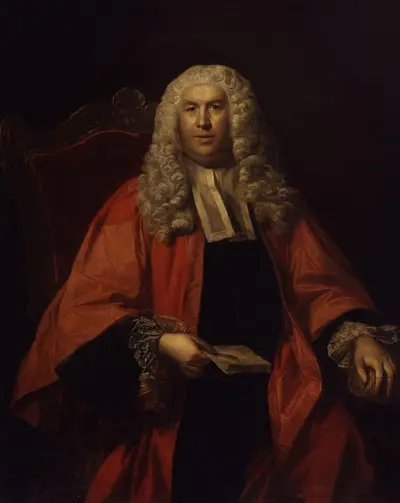
Sir William Blackstone SL KC was an English jurist, judge and Tory politician of the eighteenth century. He is most noted for writing the Commentaries on the Laws of England. Born into a middle-class family in London, Blackstone was educated at Charterhouse School before matriculating at Pembroke College, Oxford, in 1738. After switching to and completing a Bachelor of Civil Law degree, he was made a fellow of All Souls, Oxford, on 2 November 1743, admitted to Middle Temple, and called to the Bar there in 1746. Following a slow start to his career as a barrister, Blackstone became heavily involved in university administration, becoming accountant, treasurer and bursar on 28 November 1746 and Senior Bursar in 1750. Blackstone is considered responsible for completing the Codrington Library and Warton Building, and simplifying the complex accounting system used by the college. On 3 July 1753 he formally gave up his practice as a barrister and instead embarked on a series of lectures on English law, the first of their kind. These were massively successful, earning him a total of £453 (£71,000 in 2021 terms), and led to the publication of An Analysis of the Laws of England in 1756, which repeatedly sold out and was used to preface his later works.
