Richard Nixon Quotes
This son of a bitch was the worst candidate …wasn’t that fellow irresponsible …?
This statement was suppressed by the Nixon family until 2007 when it and other tapes of telephone calls were finally released to the public. Nixon won the election handily and yet was very angered at his opponent. The “irresponsibility” to which Nixon referred was McGovern raising the issue of the Nixon’s handling of the Vietnam War. See {583772} for McGovern’s reaction when he heard this for the first time more than 40 years after the fact.
Richard M. Nixon, 1913-1994, 37th President of the United States (Republican, CA), Statement about his opponent George McGovern who lost the Presidential election, Telephone Call, November 1964
Sourced by: Eigen's Political and Historical Quotations

Nixon’s remark {583773} had been suppressed by the Nixon family and McGovern and the world first heard it 40 years after the fact.


Most historians agree with Harding that he was not qualified for the job. And he personally did not have any great ambition to be president. He was a very affable man who spent much of his time drinking, playing cards, and having women entertain with his political buddies. His wife however, was a very accomplished and powerful newspaper publisher and she insisted that he run and he won. He continued his entertainment with his cronies and was a very weak president.

Romney who was typically well spoken, very frequently in his campaign speeches and appearances, made statements that were clearly untrue, and even worse statements which reinforced the negative stereotype of a disconnected rich man. Hence the joke about the muzzle.

His debating opponent, Dan Quayle, compared himself to John F. Kennedy:

Bohlen, Harry Hopkins and President Roosevelt were differing as to how to deal with one of the many ego difficulties of French leader Charles De Gaulle. Ever the diplomat, and trying to find common ground, Bohlen said:


In early 1933 President Hoover was a lame duck, but the country was in the midst of a banking panic in the Great Depression. Hoover tried to get President-elect Roosevelt to join him in some joint action, but Roosevelt didn't want to commit to anything in advance and preferred not to associate his administration with the banking debacle of the Hoover administration. He felt that the public was so soured on Hoover’s incompetence and lack of apparent empathy, that anything he did with Hoover would be perceived fas bad and doomed to failure. What Roosevelt wanted to do is diminish fear and despair and have new hope. However, Hoover was erroneously told by aids that Tugwell, a Roosevelt assistant, had suggested that Roosevelt should let the situation deteriorate, and then there would be more to blame on the Republicans when Roosevelt took office. Tugwell was as far from being a partisan politician as one could get. He was an academic with a PhD in agricultural economics. He had never been involved in politics before. Surprisingly, Hoover believed the story about Tugwell, but by then, the was a very frustrated man who felt that he had almost no good options.

Nixon agreed that that perception was prevalent among many people but said that the only way to dispel that was to win something. He won the presidency.


Congressman and later President, George


Yeltsin was the preferred choice.


This quotation is interesting for two reasons. It is a clever put down and more important it illustrates the character of public discourse in the runup to the 2012 Presidential elections. Many of the Republicans and a few Democrats had been very successful with repeated character assassination and negative campaigning about their opponents. The Republicans had become so successful, that in 2011 with a number of Republicans seeking the party nomination for the 2012 Presidential election, the aspirants and their supporters began to apply the successful techniques against members of their own party. Frum who was supporting Mit Romney had this to say about Ron Paul, another candidate, who was a libertarian and had some views that many Republicans did not care for although he had a strong base of supporters amongst Republican voters.

Baldwin when Prime Minister would not arm England to stop Germany and after he left office, supported his successor, Neville Chamberlain, in his peace efforts which turned out to be appeasement, See {626936}.
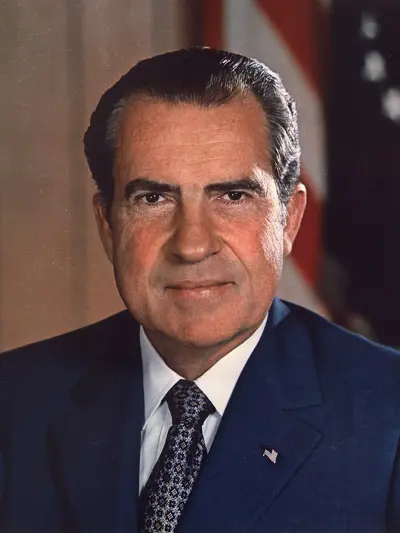
- Born: January 9, 1913
- Died: April 22, 1994
- Nationality: American
- Profession: President
Richard Milhous Nixon was the 37th president of the United States, serving from 1969 to 1974. A member of the Republican Party, Nixon previously served as the 36th vice president from 1953 to 1961, having risen to national prominence as a representative and senator from California. After five years in the White House that saw the conclusion to the U.S. involvement in the Vietnam War, détente with the Soviet Union and China, and the establishment of the Environmental Protection Agency, he became the only president to resign from the office, following the Watergate scandal.
