George McGovern Quotes
I don’t know what he was so angry about. He won…. If I had won, he would have been much better off. He would have been spared getting disgraced by Watergate.
Nixon’s remark {583773} had been suppressed by the Nixon family and McGovern and the world first heard it 40 years after the fact.
George McGovern, U. S. Congressman & U. S. Senator (Democrat, SD), Democratic Candidate for President, Reaction after hearing, for the first time, Nixon’s derogatory statements made after his 1964 victory, Interview, CBS, Sunday Morning, July 15, 2007
Sourced by: Eigen's Political and Historical Quotations

This statement was suppressed by the Nixon family until 2007 when it and other tapes of telephone calls were finally released to the public. Nixon won the election handily and yet was very angered at his opponent. The “irresponsibility” to which Nixon referred was McGovern raising the issue of the Nixon’s handling of the Vietnam War. See {583772} for McGovern’s reaction when he heard this for the first time more than 40 years after the fact.


Nixon had lied to Ford as well as the American people. Ford, having been selected by Nixon as VP, felt it was his obligation to defend Nixon until he was about to become President himself. At that point he would have destroyed his presidential credibility on top of Nixon if he kept on with the Nixon lies.


Before the 1968 election, President Johnson, and gotten the North Vietnam Communists to agree to Peace Talks with the U. S. and South Vietnam. Then Candidate Nixon thought that if the peace talks were ongoing and making progress, there would be more support for the Democrats and Nixon's opponent Hubert Humphrey. So Nixon secretly send a secret emissary to South Vietnamese President Nguyen Van Thieu telling him that he would not get a very good deal because President Nixon claimed that President Johnson was too eager to end the Vietnam war. He suggested that if Thieu boycotted the peace talks, then when Nixon was elected, he would guarantee a much better deal for South Vietnam and Thieu personally. President Thieu boycotted the peace talks and there could be no progress. However there is a Federal Law, the Logan Act, that makes it a felony for a private American citizen to conduct or interfere with foreign policy or negotiations with a foreign government. President Johnson found out about Nixon's sabotage of the Peace Talks, called Nixon (see {583263}) and threatened him with prosecution if he interfered further. LBJ had decided that with the left wing at odds with the U. S. Government over the Vietnam war, a prosecution of Nixon would cause the Right Wing to challenge the government also and the country didn't need further polarization. He would do that only if Nixon did not heed the President's warning. But when Nixon won the election and became President, he was terribly anxious that his pre-election crimes would be made public, and spent much of his time and staff effort trying to find out who knew about his politically self-serving felony and who might make his crime public.


Sung to the tune of an old English pub song, "Down at the Olde Bull and Bush." The Congressman also fancies himself a pianist.

The memo proposed having a good novelist write a fictional novel with Nixon as the main character. The great Nobel Laureate John Steinbeck was approached for the project. See {629628} for his reaction.


The Russian leadership thought little of it and assumed that it had no consequences. An American Communist official in the Kremlin, Morris Childs, told them that Nixon might actually lose his job over Watergate. Childs was actually an FBI spy. See his quote.


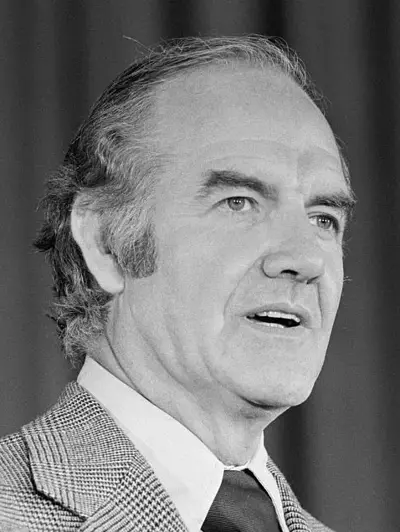
- Born: July 19, 1922
- Died: October 21, 2012
- Nationality: American
- Profession: Politician
George Stanley McGovern was an American politician, historian, U.S. representative, U.S. senator, and the Democratic Party presidential nominee in the 1972 presidential election.
