Theodore Parker Quotes
This is what I call the American idea of freedom — a government of the people, by all the people, for all the people; of course, a government of the principles of eternal justice — the unchanging law of God.
This quotation had a close proximity to Lincoln’s Gettysburg Address {458852}. Although this was probably Lincoln's most famous, was not totally original. John Adams came close in a 1774 proclamation {598723}. As did John Marshall in his McCulloch v. Maryland decision. Daniel Webster's Speech on Foot's Resolution was very close {606471}. There was also Thomas Cooper in 1795 {598723} . But the earliest close phrase use appears to be John Wycliffe in 1382 {567292}. It is not known with which of these Lincoln was familiar,
Theodore Parker, 1810-1860, Clergyman & Abolitionist, Speech, The American Idea, New England Anti-Slavery Convention, Boston, May 29, 1850
Sourced by: Eigen's Political and Historical Quotations

The government relationship to people phrase, although probably Lincoln's most famous, was not totally original. John Adams came close in a 1774 proclamation. As did John Marshall in his McCulloch v. Maryland decision. Daniel Webster's Speech on Foot's Resolution was very close. as was Theodore Parker in 1850 {629578}. There was also Thomas Cooper in 1795. But the earliest appears to be John Wycliffe in 1382 {567292}. It is not known with which of these Lincoln was familiar.

For that, the Church burned him at the stake. Note the phraseology and compare it to Gettysburg Address {458852}. It is not known whether Lincoln was aware of this quotation or others that used similar wording.

This appears to be the earliest use of the phrase Lincoln later made famous in the Gettysburg Address.


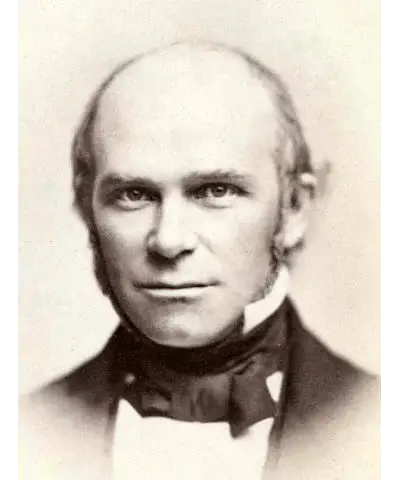
Theodore Parker was an American transcendentalist and reforming minister of the Unitarian church. A reformer and abolitionist, his words and popular quotations would later inspire speeches by Abraham Lincoln and Martin Luther King Jr.
