Robert G. Ingersoll Quotes
This crime called blasphemy was invented by priests for the purpose of defending doctrines not able to take care of themselves.
Ingersoll, Robert G. "Trial of C. B. Reynolds for Blasphemy." The Works of Robert G. Ingersoll, vol. 11, The Dresden Publishing Co., 1902, p. 69.


Rushdie was commenting on the Danish Cartoons that had been published the year before depicting the Islamic Prophet Muhammad to the great distress of some fundamentalist Muslims some of whom orchestrated riots in many countries involving much property destruction and some loss of life. See {590918} as an example of the concern.


In 2005 Rose published a number of cartoons some of which depicted the Muslim Prophet, Muhammad which offended many fundamentalist Muslims who had a tradition who had a tradition of never depicting the visage of the Prophet. A delegation of clerics demanded an apology from Rose and the country of Denmark, claiming that they and Islam, like other religions, were entitled to respect.

One irony of this statement and the belief of so many Muslims today is that in the Dark Ages when the rest of the world believed the Earth was flat, Muslim scientists and students commonly used globes to study the Earth and the Muslims preserved what was known of science.

While the Visigoths had some very advanced legal principles, this law, quoted in its entirety is typical of the nations that were part of the Catholic world. The church and its doctrines were immune from any possible criticism, explicit or implicit. This is the most formalized and sophisticated compendium of laws of the so-called “barbaric peoples” of Europe. The compilation was in many ways a documentation of the traditional laws of the Visigoths that had evolved over hundreds of years.

Spinoza was one of the most feared intellectuals in human history—feared that is by the established power structures. He is the only known person who was excommunicated by the Catholics, the Jews and the Muslims—all were forbidden to read his works. He was the enemy of authority and advocated personal reason as the guide for men.
The colonial American were quite knowledgeable about trials like this one which were occuring all over Europe. The result was the demand for the First Amendment in order to ratify the original Constitution. In this particular case, the major crime that triggered the investigation and trial was the fact that La Barre did not remove his hat in respect as a religiohs procession of Corpus Christi went by. During the investigation, the mayor searched La Barre’s residence and found blasphemous literature the worst of which appeared to be Voltaire’s Philosophical Dictionary which the Mayor ordered to be burned along with the head and body. The photo is a plaque in Abbeville to the victim reminding all of the danger of mixing religion in civil law.

This is a typical law in most modern Muslim countries. Essentially, Muslim Sharia Law prohibits any insult to the Prophet, the Koran and other sayings of the Prophet. This law of course, violates the UN Declaration of Human rights and freedom oriented counties tend to deride the restrictions of freedom of speech and expression. However, to show that the Muslim nation is being “fair”, laws like this one supposedly “protect” people of other religions from the wounding of religious feelings when their religion is slandered. Christians and other non-Muslims are prosecuted commonly. At the same time, ultra-fundamentalist Muslim clerics and teachers at religious schools commonly preach hate and desecration of Christianity, Judiasm, and Hinduism commonly. None are ever prosecuted.

Ingersoll was considered to be the greatest orator and political thinker of his day, but his overt atheistic views curtailed his elected political career.


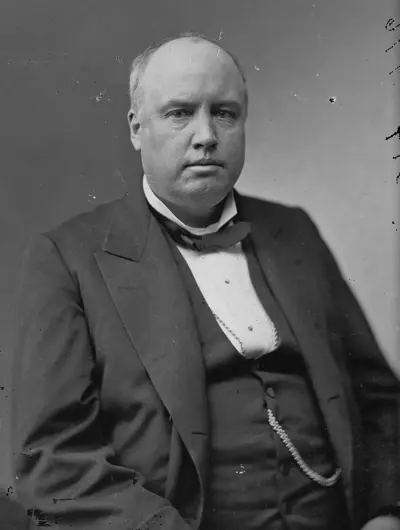
Robert Green "Bob" Ingersoll was an American lawyer, a Civil War veteran, political leader, and orator of the United States during the Golden Age of Free Thought, noted for his broad range of culture and his defense of agnosticism. He was nicknamed "The Great Agnostic". Ingersoll was considered to be the greatest orator and political thinker of his day, but his overt atheistic views curtailed his elected political career.
