Friedrich Engels Quotes
Things go wrong in America.... What cowardice in government and Congress! They are afraid of conscription, of resolute financial steps, of attacks on slavery, of everything that is urgently necessary; they let everything loaf along as it will, and if the semblance of some measure finally gets through Congress, the honorable Lincoln so qualifies it that nothing at all is left of it any longer.
At the beginning of the Civil War, Lincoln and many of the Union politicians hoped that the South would “come to its senses” and end the rebellion. As a result, they did not want to take all the draconian steps that they were able to. They wanted to give the Southern moderates room to maneuver and persuade the firebrands. However, there was a fundamental issue at stake—slavery—where there was no real compromise left that would have any lasting effect. The slaveholders would be destroyed in their view—possibly by the war, but certainly in the Union where the majority was strongly opposed to slavery on moral grounds.
Friedrich Engels, 1820-1895, German Socialist & Revolutionary Theorist July 31, 1862
Sourced by: Eigen's Political and Historical Quotations

This Civil War recruiting poster was described by the Free Library of Philadelphia as “Civil War recruitment print targeting African Americans by evoking the freedoms granted by the Emancipation Proclamation. Depicts a montage of symbolic scenes centered around an African American Union soldier triumphantly holding up a sword and an American flag with the banner "Freedom to the Slave." He stands near broken shackles upon a tri-color flag adorned with a coiled snake. The flag is tugged upon by one of three joyous slaves freed by an African American soldier. Other scenes depict an African American man reading a newspaper on a rocking chair near a plow and child, African American children entering a "Public School" near a church, and a regiment of "U.S. Colored Troops" marching across a battlefield strewn with dead bodies.”


President Andrew Johnson had been impeached by the House of Representatives and was being tried in by the Senate. A majority of the Senators voted for conviction but the vote was 1 short of the two-thirds that were needed. Johnson remained in office.

Marx followed the American Civil War very closely. The freeing of the slaves caused an immediate social, moral and economic revolution, the results of which we live with today.


Fremont and some of the Radical Republicans wanted Lincoln immediately to declare the slaves of the rebelling states free. As a major general in charge of an area, he wrote a military order emancipating all the slaves in his jurisdiction. President Lincoln countermanded the order as soon as he found out. He wanted Fremont to only free the slaves whose owners were actively working against the union. Lincoln needed to hold the border states like Maryland in the Union and was working on a plan whereby slave owners who were loyal to the Union would be economically compensated when their slaves were freed. If loyal slaveholders in Fremont’s area would lose their slaves with no compensation, Lincoln feared that the otherwise loyal border states would be driven to the confederacy thus shifting the balance of power. Lincoln had his own plan for emancipation and would not allow Fremont to alter that. As a result of this speech, the Radical Republicans nominated Fremont to run against Lincoln. For a few weeks he looked like he would run, but then he and Lincoln made a deal. Lincoln fired Montgomery Blair, Fremont’s arch enemy, from the cabinet, and Fremont withdrew from the election.


While Lincoln was morally opposed to slavery, at the time the Civil War was not going well for the Union. The Emancipation Proclamation caused the South great distress in terms of practicality and their morale. The slaves if they escaped could come to a Union State and would be forever free. The South would lose labor that they could ill afford to lose as well as they were forced to devote more white manpower to keeping the slaves in bondage. While most people think the Proclamation freed all the slaves, it did not; it only freed slaves in the rebellious Southern states. Border states such as Maryland, not in rebellion, could keep their slaves legally and did until they were freed later.

In what turned out to be a tragic prediction of things to come:
In the Civil War a drafted conscript could pay money instead of serving in the army. Many rich and middle class men did so leaving a higher proportion of the poor to be drafted. The song is sometimes misattributed to William Cullen Bryant.


Until the Civil War, every territorial issue in American politics was colored by the slavery question. The South, even with its advantage of counting slaves as three-fifths of a person was inexorably losing proportional Congressional strength as the growth rate of the free states was much greater. So there would be a pro-slavery movement in every new territory. Wilmot and others were determined that after slavery had been outlawed for two decades in California before the territory became affiliated with the United States, that slavery not be reintroduced which is just what the Southern pro-slavery forces were trying to do. The amendment passed handily in the House but was killed in the Senate where Southern strength was proportionately stronger.


After the Presidential years of James Buchanan who protected the South from slavery reform and abolition as the North was gaining political power and the abolitionists were having a greater and greater effect on public opinion in the North. While Southerners did not believe Lincoln would emancipate the slaves, they realized that the majority of the growing nation was opposed to slavery, and more and more Northern states were passimg laws making any slave who sets foot in the State a free person. Slaves coud not only have more reason to run away, but slave owners would not be able to get their “property” back. Lincoln would not help the South as Buchanan did, and the Southerners realized that over time, slavery would no longer be feasible or profitable. Cobb, very experienced at Washington politics, realized the changes that would come and thought that they would be “certain and speedy.” The irony was that if the South had not seceded and simply dragged its feet legislatively, it would have taken two or three decades for slavery to end. However, by seceding and initially fighting so hard and well while poor Union generals were in command, Lincoln was forced to try more drastic measures and issued the Emancipation Proclamation after only a few years. The Civil War and seccession was not only a tactical and strategic error for the South, but rapidly brought about just what the Southerners were fighting to prevent.

Some Lincoln critics point to this quotation to illustrate their belief that Lincoln’s emancipation of slaves was not based on deeply held personal moral convictions but was the result of pragmatic political forces pure and simple. Others believe that this statement to Greeley represented a political tactic to hold Maryland and Kentucky—then slave states—in the Union, but that Lincoln was waiting for the right time to adopt a policy of making emancipation paramount.

He stated that he had a vision and made these two prophesies that indeed came true. The first was the South Carolina secession starting the Civil War. The second, when the North used former slaves as soldiers who fought their old masters.
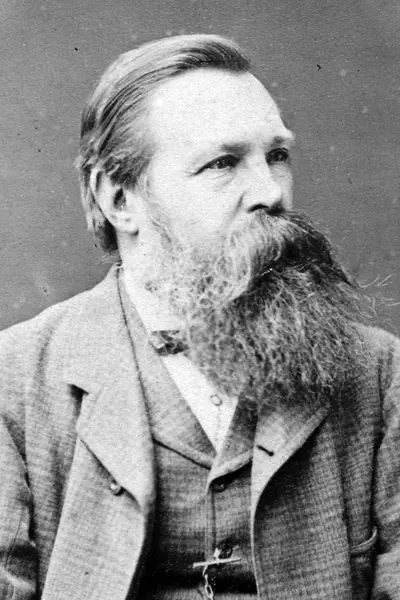
Friedrich Engels (/ˈɛŋ(ɡ)əlz/ ENG-(g)əlz, German: [ˈfʁiːdʁɪç ˈʔɛŋl̩s]), sometimes anglicised as Frederick Engels, was a German philosopher, economist, historian, political theorist and revolutionary socialist. He was also a businessman, journalist and political activist, whose father was an owner of large textile factories in Salford (Lancashire, England) and Barmen, Prussia (now Wuppertal, Germany).
