Samuel Johnson Quotes
They [the American colonists] are a race of convicts, and ought to be thankful for anything we allow them short of hanging.
Samuel Johnson, 1709-1784, English Writer & Lexicographer, Boswell's The Life of Samuel Johnson, March 21, 1775
Sourced by: Eigen's Political and Historical Quotations

“Transported” meant they were convicted criminals in England who were sold into indentured servitude for a number of years. When their sentence was up, they became free but had no assets or land, so they went to the frontier and settled on land there which sometimes was Indian occupied land, but was more often Indian hunting land. This often caused friction between the new Americans and the Indians. The original criminal origin of these Americans was constantly views in a negative light by the upper class English (See {605546}.). He was the de facto Governor of the colony as there was no one senior to him on the American side of the Atlantic.

Burke was one of the many members of the English Parliament who were opposed to a hard line in America in the beginning of the American Revolution and favored withdrawal after the hostilities began. The hard liners won un England and America was lost.

St. Domingue was the name of Haiti which had had the only successful national slave revolt, but it was incredibly bloody with many casualties.


Early in his career, Santa Anna was an enthusiast for democracy. However, the republican form of government did not work at the time in Mexico and he developed into a despot and dictator.


Chile with help from San Martin had ejected the Spanish. O’Higgins, the Chilean leader had joined up with San Martin and served under his command. The sectional rivalry bothered men like Carrera. Instead of seeing all the South Americans fighting the Spanish as allies as O’Higgins did, Carrera and his brothers refused to join a government of unity and they and their troops were just as dictatorial and cruel as the Spanish had been. O’Higgins gave Indians and Blacks equal rights with whites which distressed the aristocratic Carrera’s. Finally the Carrera’s tried to set up their own government, and the new Chilean government disarmed their militia and executed two of the three Carrera brothers who were leading the militia troops who were little more than thieves and brigands.

There was continuing tension between England, the Colonial Governors of South Africa and the Boers. Immigrant settlers to South Africa from Holland. The Boers were very uneducated and not steeped in democratic government. They wanted to enslave and sieze the land of the Black residents. Under English law, the Blacks were also English subjects. The Boers insisted that any interference in their persecution and enslavery of the Blacks was oppression just as the Southern American Whites saw Reconstruction defense of the Blacks as oppression to them. The classic question is: “Is it oppression to stop people from opressiong others?”


The organization sent 2,100 volunteers to fight for South American independence from Spain.


The IRA had just murdered Lord Mountbatten with a bomb on his small boat. Mountbattten, then a 79 year old, elderly man in retirement was a member of the Royal Family. His grandson was also murdered. Mountbatten had not had anything to do with Ireland but to the IRA he was a symbol of British imperialism since he had been the British Viceroy of India. Actually, it was he who had organized and presided over Indian Independence.

Ministers refers to the Government Ministers, not to clergy.

William V, Prince of Orange, was in a very precarious position and might be deposed. Officially Harris and the British were supporting him and Harris was giving him money to firm up his regime, but their great fear was that the French would support and control the Patriot Revolutionary movement, then quite active. And William was very tentative in dealing with the growing Patriot revolutionary movement. Actually, to cover all eventualities, Harris was secretly aiding the Patriots as well. See {639752}.

While the official battles of the American Revolution did not begin until 1776, parts of the American colonies were in a de facto state of rebellion and the British could not enforce their laws. See {636925} for another of the King’s statements.
He was acting as French Foreign Secretary at the time.


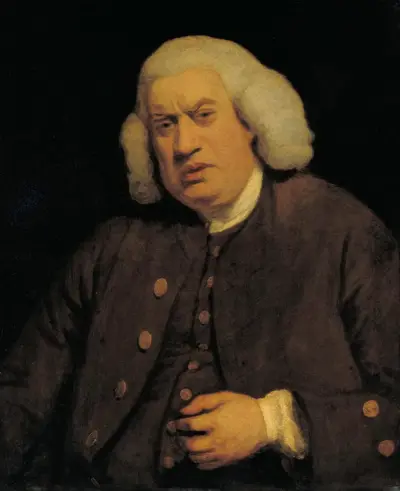
- Born: September 18, 1709
- Died: December 13, 1784
- Nationality: English
- Profession: Poet, Playwright, Essayist, Moralist, Literary Critic, Biographer, Editor, Lexicographer
Samuel Johnson, often referred to as Dr Johnson, was an English writer who made lasting contributions to English literature as a poet, playwright, essayist, moralist, literary critic, biographer, editor, and lexicographer. Religiously, he was a devout Anglican, and politically a committed Tory. The Oxford Dictionary of National Biography describes Johnson as "arguably the most distinguished man of letters in English history". He is the subject of James Boswell's The Life of Samuel Johnson, described by Walter Jackson Bate as "the most famous single work of biographical art in the whole of literature".
