Ben Bernanke Quotes
There's no denying that a collapse in stock prices today would pose serious macroeconomic challenges for the United States. Consumer spending would slow, and the U.S. economy would become less of a magnet for foreign investors. Economic growth, which in any case has recently been at unsustainable levels, would decline somewhat. History proves, however, that a smart central bank can protect the economy and the financial sector from the nastier side effects of a stock market collapse.
Bernanke, Ben S. "Asset-Price 'Bubbles' and Monetary Policy." New York Chapter of the National Association for Business Economics, 15 Oct. 2002.


She was refuting the claim of many economic conservatives that cutting taxes will always produce economic growth. Actually, in many cases tax cuts do have that effect, but as the counter-example shows, not always and not under all conditions. The Kennedy tax cuts, for example, did produce economic growth.

The Progressive article was an interview with Movie Director and Screenwriter Oliver Stone who told the interviewer that he had learned of this quotation when he did his research for his film, South of the Border where he had several interviews with President Kirchner.

The most successful way of poor nations developing rapidly is to trade with rich nations.
_0_thumbnail_47x47.jpg "Bill White, Mayor of Houston, Texas")

His prediction was accurate and the consequence was an increase in the production of agricultural products and a shrinking proportion of Americans employed in farming and ranching.

See {585931} for a stark view of the importance of perception.
This quotation is important as it provides a major counter-example to the ideological political belief that tax cuts and deregulation produce economic growth. Sometimes they do, but other times they do not. Ironically the greatest periods of growth in the last half of the 20th century included some of the highest rates of taxes. At other times high taxes curtailed growth. As with many political ideologies, they are really not principles or laws of nature or economics, but political preferences.


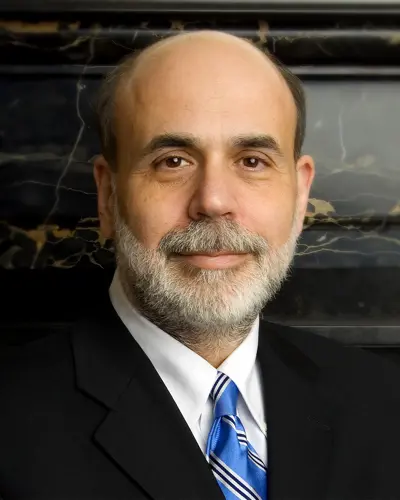
Ben Shalom Bernanke is an American economist at the Brookings Institution who served two terms as the 14th Chair of the Federal Reserve, from 2006 to 2014. During his tenure as chair, Bernanke oversaw the Federal Reserve's response to the late-2000s financial crisis, for which he was named the 2009 Time Person of the Year. Before becoming Federal Reserve chair, Bernanke was a tenured professor at Princeton University and chaired the department of economics there from 1996 to September 2002, when he went on public service leave.
