John William De Forest Quotes
There was surely not a third of the usual shipping, nor a quarter of the accustomed cotton. Here and there were wharves perfectly bare, not only of masting and of freight, but even of dust, as if they had not been used for days, or possibly for weeks.
At the beginning of the Civil War, he was a civilian and was visiting Charleston, the largest port of the South. The quotation has historical importance as it shows the huge effect that the beginning of the Civil War had on the Southern Economy. .Fort Sumter had been taken and South Carolina had seceded a few weeks earlier.
John William De Forest, 1826–1906, Historian, Writer, Soldier, & Administrator, Adjutant General, Union Veteran Reserve Corps, Assistant Commissioner, Freedmen's Bureau, Description of the Southern Port of Charleston, South Carolina, “Charleston Under Arms”, The Atlantic Monthly, April 1961
Sourced by: Eigen's Political and Historical Quotations


In international law, a blockade is an act of war by the brocading country against the country that is blockaded—not against 3rd parties that may have to obey the blockade. For example before the War of 1812, France and England were at war and each blockaded the other’s ports. The United States was affected by the blockade in that our ships could not go in or out of blockaded ports with goods. However nether country was at war with us. All neutral nations must respect a blockade or the blockading nation is entitled to use force to enforce the blockade, but that is not an act of war. In 2011, Gaza was at war with Israel, and Israel blockaded Gaza. A Turkish ship tried to bring goods to Gaza and Israel seized the ship by force and brought it into a near natural port (Egypt). Israel was entitled to enforce its Gaza blockade, but they were not at war with Turkey. However if Israel, blockaded a country where there was not an existing war, the blockade itself would be an act of war.

This quotation is interesting as it shows that and the end of the 19th century, although the United States was over 100 years old, we were first beginning to be major world traders. Not that our merchant marine was not yet world class. Another interesting facet of the quote is that the President was claiming that foreign trade was good for the domestic economy. Much of America in its first 100 years supported protectionism for American manufacturers.

More new technology was deployed in the Civil War than any other war in history and Moltke did not realize that the classic European military tactics were obsoleted. However, neither did most of the Southern Generals and many of the Union Generals. Lincoln, Grant and Sherman were the ones who developed strategies and tactics to function in the new world of warfare.

There was a time when American business was not particularly interested in foreign markets. The entire nation was much more isolationist then.


He is also referred to as Josiah Quincy Jr. At the time most historians believe that Charlestown was the 4th largest seaport after Boston, New York and Philadelphia. But at certain times if Quincy is to be believed, Charleston handled large increments of shipping.


President Lincoln and Several of the Commanding Union Generals had declared that black slaves were free during the midst of the Civil War under the legal theory that if the slaves were property of the rebels, then they cold be seized as “contraband” and removed from the control of those who had committed treason. The question was, what would happen to those now free Negroes after the war? Many Negro leaders were anxious that if there were surrender, then the status quo ante might prevail and the Negroes—many have who had fought for the Union might be returned to slavery. This speech by the Secretary of State alarmed them further. This is why the Emancipation Proclamation was so important and even that might have been overturned by a subsequent President. This is why Lincoln, the white radical Republicans and the Black leadership placed so much emphasis on passing the 13th Amendment.

Like many war leaders, Davis tried to dehumanize the Northerners, against whom the Confederates were fighting. His “”theory” was that The Southerners were the good and upright sons of the Founding Fathers but the Northerners were the “degenerate” sons.

One of the puzzles of American Civil War history has been how the poor whites of the South (who provided most of the military manpower that fought and died in the Civil War) were persuaded to fight against a much stronger, more highly industrialized, and more affluent few, that had many more soldiers. One of the main reasons, though difficult for us to understand today, was that the Southern leadership actually persuaded the Southerners that men from the North were cowards and lacked the character, virtue or will to fight. The general “party line” of the South was that one Southern solder was worth more than 5 Northern Soldiers,
Armstrong was a Union military chaplain with the troops that had captured Petersburg, Virginia. Of particular interest in this quotation is his report on the attitude of the poor whites after the war had destroyed the economy of the area and reduced the former wealthy aristocrats to poverty.
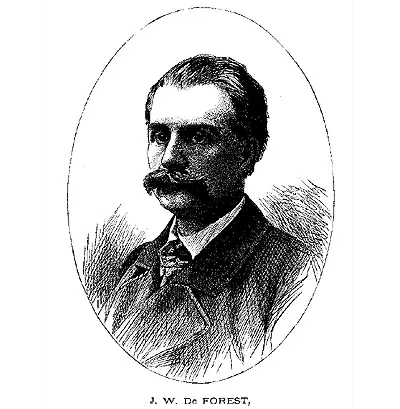
John William De Forest was an American soldier and writer of realistic fiction, best known for his Civil War novel Miss Ravenel's Conversion from Secession to Loyalty.
