Wat Tyler Quotes
There should be only one bishop in England and only one prelate, and all the lands and tenements now held by them should be confiscated, and divided among the commons, only reserving for them a reasonable sustenance.
Tyler and his movement of peasants also wanted all priests to have just enough wealth and property for their own sustenance with the remainder divided among the peasants just like the Bishops’ properties.
Wat Tyler, ?-1381, English Peasant's Revolt Leader, Demand of King Richard, 1381, Quoted in Anonimalle Chronicle: English Peasants' Revolt 1381
Sourced by: Eigen's Political and Historical Quotations


In modern America, there are two political views of this notion. The one held by a narrow majority of the population is Trenchard’s quotation taken literally. Their view is that there is no way to maintain liberty if there is too wide a wealth gap between the rich and the rest of the population. The second variant, held by many conservatives, limits the equality to equality of opportunity. They are loathe to take any position that says that any gap between the rich and the remainder of the citizens might be too large. They would particularly disagree with the first sentence of this quotation. Another consideration is that this quotation does not even consider what became a major problem in the American Democracy—the ability and propensity of the very rich to bribe legislators and officials and/or make “campaign contributions” to obtain favorable treatment and/or “access”.

This was before the state had officially sanctioned and accepted the church. Most of the institutions were pagan and the kings had subjects of both religions with Christianity not yet dominant. Yet among Christians, the Church had government temporal power, even before the church was allied with the state.


He was summarizing impeachment under English law. The impeachment concept was borrowed by the Founding Fathers in the U. S. Constitution. See {584247}.

Some politicians then and later were not as religious as the leading clerics would prefer. The quotation shows that priests commonly married at that time even though the church had forbidden it.

Writing about the railroad magnates and monopolists of his day:


At this point in the convoluted history of Irish-English politics, the majority of the Irish upper class and members of Parliament were large landholders whose estates had been accumulated and legalized under English
Sealed under duress and later repudiated by the King with Papal assistance
Sealed under duress and later repudiated by the King with Papal assistance. This clause was particularly interesting in that almost all freedoms have expanded from the Magna Carta in modern democracies. However in this one there was an absolute direct prohibition against the King—the State—taking private property without the owners consent. In modern democracies the right is not as strong as the original. The state, if it needs the property, wood or whatever, and the owner refuses to give it or sell it to the state, the government can condemn the property but must pay the owner the fair market value of the property seized. As a practical matter, the kings of England paid little or no heed to this clause. One of the sources of conflict between the English Royal Navy and the American Colonists was the practice of Naval agents finding tall straight trees, good for the main mast of a ship, and marking it thereby prohibiting the property owner of cutting down that tree until the Crown sent a crew to fell the tree and take it for ship building. They paid no attention to Aticle 31 whatsoever.


Gregory the Great. “Emoluments” included the income from all lands and other church property, gifts and tithes, and income of any sort. This formula characterized the division of resources for the better part of Christian history. By today’s standard, the proportion for these Bishops (there were those who chose poverty) and his household seems astoundingly high—his income and sustenance was the equal of all the priests in the bishopric. It illustrates the affluence of the bishops who were major forces in their territories. One of the rationales for such an affluent bishop (the assets were not all personal but he had control of them) was that he should be at least the equal of any in the area including kings and nobles for he was to have as much influence as they. It is difficult today to look at modern bishops and realize how their role, power, relative wealth, and influence has changed. Bishops had their own armies, judiciary, accountants, attorneys and were a government unto themselves.
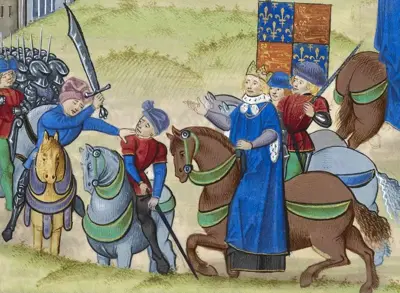
Walter "Wat" Tyler was a leader of the 1381 Peasants' Revolt in England. He marched a group of rebels from Canterbury to London to oppose the institution of a poll tax and to demand economic and social reforms. While the brief rebellion enjoyed early success, Tyler was killed by officers loyal to King Richard II during negotiations at Smithfield, London.
