Ruhollah Khomeini Quotes
There is no room for play in Islam ... It is deadly serious about everything.
Most Muslims do not agree that play and recreation are anti-Islamic. There are some fundamentalist Christian sects that do not allow dancing or other forms of recreation, The Puritans had such a philosophy.
Ruhollah Khomeini, 1900-1989, Iranian Cleric [Ayatollah] & Revolutionary Leader, Speech, Qum, Iran, 1980, Quoted in Time, January 7, 1980
Sourced by: Eigen's Political and Historical Quotations


See Quadratullah Jamal {604665} and {604664}.


In 2005 Rose published a number of cartoons some of which depicted the Muslim Prophet, Muhammad which offended many fundamentalist Muslims who had a tradition who had a tradition of never depicting the visage of the Prophet. A delegation of clerics demanded an apology from Rose and the country of Denmark, claiming that they and Islam, like other religions, were entitled to respect.

At the time Islam was quite conflicted about the role of innovation, science and reform. Innovators were to many theologians as dangerous to society as heretics and had to be refuted. Al-Ashari’s school of thought has prevailed in much of the Muslim world to this day.


See {608419}, {604665} and {604664} regarding the government’s destruction of Buddist statues.


The import of this principle is that if a member of the family is not a good Muslim, then that member is no longer to be treated as and is not a relative any longer. Qutb cites the example of Abdullah bin Abdullah bin Ubayy, a contemporary of the Prophet’s whose father had opposed Islam and therefore must be punished. He quotes the man as telling the Prophet: ‘if it is the pleasure of God and His Prophet that I cut off my father’s head, then I shall do so.’

The Chinese were lovers of kite flying and this sport spread throughout Asia and became a favorite in Afghanistan. However, it was never mentioned in the Koran, and therefore to the Taliban was not desired by God. This ultra fundamentalism not only prohibits what the Prophet forbade, but also forbids that which he did not mention.


Bangladesh had fared very poorly as a part of Pakistan. When it revolted and became independent, it adopted a secular government whereas Pakistan had been, and is, a heavily Islamic state. However, the vast majority of Bengalis were Muslim and some were extreme fundamentalists. Rahman was under constant pressure to make the government more “Islamic” and while he did so somewhat, he tried to advocate for separation of church and state. Bangladesh is not as extreme as Pakistan which is not yet a theocracy but religious forces dominate every aspect of the society.

This quotation which appears absurd on the surface given Iran’s terrible record with religious minorities provides insight to Islamic orthodox thought. For the orthodox Muslim, Sharia—Koranic Law—is the basis of the society. God defines the rights of people and their obligations. Whatever rights are provided by Sharia, Khomeini and some others wished to provide them equally to religious minorities also. However, those rights do not include the right to criticize the Islamic law or the leaders who implement it. That would be heresy if done by a Muslim, a Christian, or a Jew. A Christian church may not erect a public cross or ring bells on Sunday. That is prohibited by the Koran and is imposed on all. Bahai religious adherents are tracked down in the Islamic Republic and are often executed. ‘What about their rights?’ they ask. The answer is that the Bahai were Muslims who have become “backsliders” and heretics, and under Sharia, they must be executed for heresy; they are deemed to be heretical Muslims and not members of a minority religion.
Ahmad denied saying this although the reporter who wrote the original story insists that he did and she wrote it down at the time. Ahmad did not deny the statement when it first appeared in the Fremont Argus, but only did so several years later.


They are so different that most people in the West think of what Khamenei describes as “religious democracy” as not even close to democracy—almost the antithesis of democracy, and Islamic fundamentalists perceive Western democracy as sinful and evil.
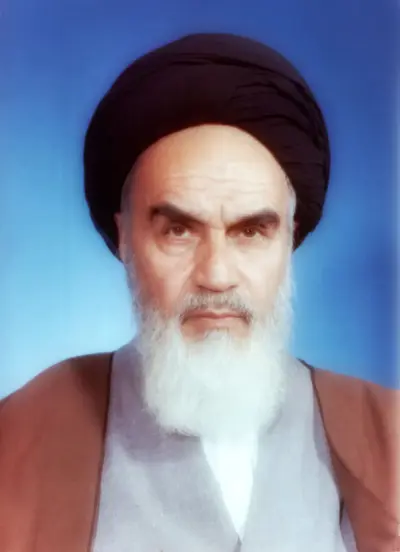
Sayyid Ruhollah Musavi Khomeini, also known in the Western world as Ayatollah Khomeini, was an Iranian political and religious leader. He was the founder of the Islamic Republic of Iran and the leader of the 1979 Iranian Revolution, which saw the overthrow of the last Shah of Iran, Mohammad Reza Pahlavi, and the end of the 2,500-year-old Persian monarchy. Following the revolution, Khomeini became the country's Supreme Leader, a position created in the constitution of the Islamic Republic as the highest-ranking political and religious authority of the nation, which he held until his death. Most of his reign was taken up by the Iran–Iraq War of 1980–1988. He was succeeded by Ali Khamenei on 4 June 1989.
