Dwight D. Eisenhower Quotes
There is no person in this room whose basic rights are not involved in any successful defiance to the carrying out of court orders.
Eisenhower, Dwight D. Public Papers of the Presidents of the United States: Dwight D. Eisenhower, 1957. Office of the Federal Register, 1958, p. 690.


Note the use of the phrase “against the government.” One of the unique aspects of the American Constitution and The Bill of Rights is that the government is considered a potential and even probable infringer on the liberties of the people. It is almost as though the government was the potential enemy. Modern libertarians state this very explicitly and it is ever present in the views of both the right and left wings of American politics. Most centrists recoil at the thought that some citizens see the government as the enemy, but even in America there have been times where the government has infringed on the rights of citizens only to have the courts or future administrations and Congresses correct the error.


Federal officials and commissioners issued laws, directives and orders that were very unpopular with the Mormons who were in the overwhelming majority of the Utah territory. The Mormon “government” was a type of theocracy but a very popular one. The Mormons tried to test the constitutionality and legality of the Federal laws and orders before they would obey. The government position was that they should obey and then could test the laws in the courts. The Mormons eventually lost in the courts anyway, but the principle of obedience to law until it can be tested and reversed has generally been the rule of U. S. Law. However, civil disobedience in which many religions have engaged in our history argues the obverse. Eventually Taylor had to go “underground” and rule the church from exile in which state he died.


Many New Yorkers and others felt that since the attack on the World Trade Center was made in the name of Islam, the mosque and commuity center should be built in another location further from Ground Zero. Ellison was debating someone who argued that the Mosque should not be built so that sensitivity can be shown for those New Yorkers who lost relatives and friends in the attack of September 11. Rather than insist on their Constitutional rights, the Muslim leadership of the project, moved the location somewhat further away from Ground Zero.

This was written during the George W. Bush Administration where the reaction to 9-11 was to curtail some civil rights and constitutional protections in favor of more national security. Bush was not the only President who eroded civil rights in a fear for National Security. FDR interned the Japanese Americans. Woodrow Wilson jailed pacifists who protested against the draft. John Adams passed the infamous Alien & Sedition Acts.

Johnson, fundamentally an inveterate racist, tried to kill all attempts at protecting Negro rights after the Civil War. Congress rewrote the Bill to obtain enough signatures and then passed it over the President’s Veto later in the year.

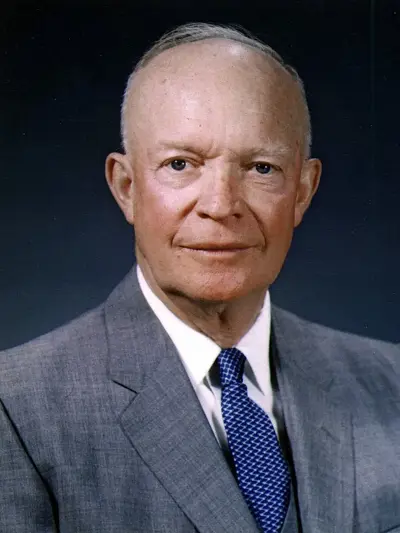
Dwight David "Ike" Eisenhower GCB OM GCS CCLH KC NPk was an American military officer and statesman who served as the 34th president of the United States from 1953 to 1961. During World War II, he became a five-star general in the Army and served as Supreme Commander of the Allied Expeditionary Force in Europe. He was responsible for planning and supervising the invasion of North Africa in Operation Torch in 1942–43 and the successful invasion of Normandy in 1944–45 from the Western Front.
