Henriette Caillaux Quotes
There is no more justice in France. There is only the revolver.
The editor had discovered that she and her husband had had an affair before they were married and she was still married to another man. This would have ruined her husband’s political career and she decided to prevent that by killing the editor with the information. She was tried for murder and acquitted on the grounds that this was not a rationally premeditated murder but the uncontrollable emotional reaction of a woman who was so weak that she had no control over her actions. This was the excuse that the jury needed, as the personal slandering of politicians for things unrelated to their political activity was becoming very unpopular. This affair was the beginning of the tendency of the French media to not write about the personal and sexual activities of politicians which became a strong cultural tradition.
Henriette Caillaux, 1874–1943, French Socialite & Wife of then Former French Prime Minister Joseph Caillaux, Statement to the police when she shot the editor of the newspaper Figaro, March 16, 1914
Sourced by: Eigen's Political and Historical Quotations


Mashall was then Solicitor General of the United States.


He was warning that the corporations and monopolies were taking advantage of the poor who, if there is not some balance of redress and justice will resort to violence such as the man who just short him. He gave the speech still bleeding with the bullet lodged in his body. He refused to go to a hospital or get medical care until he had finished his speech. See {633076}.


There were anti-Vietnam war protests going on throughout the country that year. In many of them, especially at universities, protesters took over buildings, and shut down operations. Most Republicans and many Democrats wanted the protests to end, mostly because they feared the spread of the anti-Vietnam war sentiment would catch on and become a position held by most Americans (which it did just as they feared,) They were restrained in what they could do legally by the 1st Amendment. However, there was much breaking of minor laws in many of the demonstrations and that was the focus of the effort to suppress the demonstrations. But in the tradition of civil disobedience, it was the lawbreaking that tended to get the press attention and coverage, so the leaders of the anti-war movement advocated even more lawbreaking, hence Dirksen’s statement to the convention.


Charles I had caused the death of his subjects with impunity and was called to account. However, the English Parliament did not know what specific crime the King had committed. Kings had executed people, guilty of crimes and otherwise, for centuries. For what could a king be accountable. Cooke developed the crime of Tyranny and drew up and presented the indictment for that. The King was found guilty and executed. This was the first time in legal history that a ruler was called to account for crimes committed against his own people. It became the foundation for many trials thereafter including that of Saddam Hussein in 2006.


Odo of Chatillon-Sur-Marne. The Pope was addressing officials of Christian counties throughout Europe. Crime control then seems to have been a hot political issue as it is today.


“Factions” was the word for political parties then.


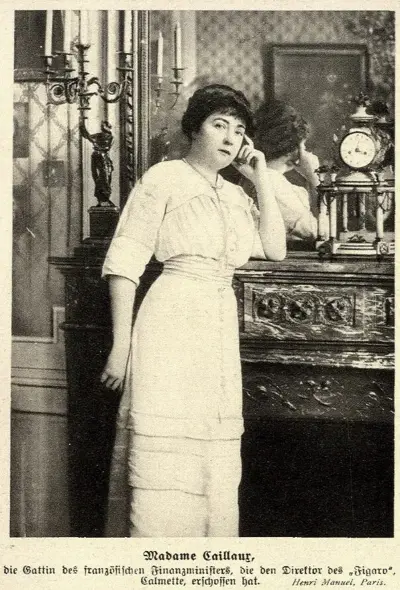
Henriette Caillaux was a Parisian socialite and second wife of the former Prime Minister of France, Joseph Caillaux. On March 16, 1914, she shot and killed Gaston Calmette, editor of the newspaper Le Figaro.
