John Marshall Quotes
There are men who will hold power by any means rather than not hold it; and who would prefer a dissolution of the union to a continuance of an administration not of their own party. They will risk all ills ... rather than permit that happiness which is dispensed by other hands than their own.
John Marshall, 1755-1835, Chief Justice of the U. S. Supreme Court, U. S. Congressman (Federalist, VA), U. S. Secretary of War, U. S. Secretary of State, Quoted in Beveridge, Life of Marshall, II
Sourced by: Eigen's Political and Historical Quotations


Because of the contested Electoral College vote in the 1876 election, a special commission was set up by Congress to decide "as to which is the true and lawful electoral vote" from those states where more than one return was recorded by the College. On March 2, Republican Rutherford B. Hayes was selected President over Samuel Tilden.


His use of the noun “Democracy” refers not to a form of government but the specific institution of the Democratic Party. Smith, like many of the Founding Fathers was deeply suspicious of political parties. See also {614907}. Smith had written to most of the then likely Presidential candidates of both major parties asking for their position on the Mormons who were facing persecution wherever they went. None of the politicians would make any satisfactory commitments. Smith took Direct Action and became the only major religious official to have run for the Presidency of the United States until Pat Robertson tried and failed in 2000. Smith’s assassination shortly thereafter cut his run for the Presidency short before it made much headway and politically he had no chance to affect the race.


Platt was the boss of the Republican Party which controlled New York State, His personal office was at 49 Broadway in New York City. See {622998} for more on Platt power in New York.


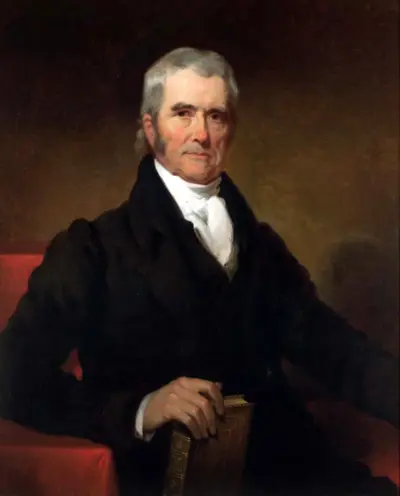
John Marshall was an American politician and lawyer who served as the fourth Chief Justice of the United States from 1801 to 1835. Marshall remains the longest-serving chief justice and fourth-longest serving justice in Supreme Court history, and he is widely regarded as one of the most influential justices to ever sit on the Supreme Court. Prior to joining the Supreme Court (and for one month simultaneous to his tenure as Chief Justice), Marshall served as the United States Secretary of State under President John Adams.
