Joseph Smith Jr. Quotes
Democracy, Whiggery, and Cliquery, will attract their elements and foment divisions among the people, to accomplish fancied schemes and accumulate power …
His use of the noun “Democracy” refers not to a form of government but the specific institution of the Democratic Party. Smith, like many of the Founding Fathers was deeply suspicious of political parties. See also {614907}. Smith had written to most of the then likely Presidential candidates of both major parties asking for their position on the Mormons who were facing persecution wherever they went. None of the politicians would make any satisfactory commitments. Smith took Direct Action and became the only major religious official to have run for the Presidency of the United States until Pat Robertson tried and failed in 2000. Smith’s assassination shortly thereafter cut his run for the Presidency short before it made much headway and politically he had no chance to affect the race.
Joseph Smith, Jr., 1805-1844, Founder of the Mormon Religion, General Smith's Views on the Powers and Policy of the Government of the United States, Platform for his run for the Presidency, February 7, 1844
Sourced by: Eigen's Political and Historical Quotations

One of their friends was then Judge Stephen Douglas who advocated equality for Mormons and appointed Mormons to various posts. Mormon support helped the Democrat’s Thomas L. Ford win the next gubernatorial race over his Whig opponent who was virulently anti-Mormon.


In Dolgoff’s era, his argument was that the political parties were so powerful that it was they who controlled who held public office, not the voters. And the parties were controlled by a few party leaders. However, when the system was reformed in the latter part of the 20th century, the individual incumbent member of Congress in America was so hard to dislodge due to the role of money and the advantage of incumbency, that the class of professional politicians was still very powerful. Reform had reduced the control of political parties but not politicians.

In the struggle for political power, this is often forgotten. During the Barak Administration, the President proposed measures that had been introduced and supported by his Republican opponents earlier. But they then not only failed to support them but often filibustered in the Senate to block them. The Democrats failed to support some of their ideas when President Eisenhower introduced them.

A major problem of new and emerging democracies is that many people believe that majority rule per se is democracy. In Egypt for example, Morsi and his Muslim Brotherhood won the election. They then assumed that they had the right to do anything including exempting the government from judicial review or deciding the role of women in society or denying freedom of religion to non-Muslim citizens. Democracy is not a serial autocracy with each new autocrat being selected by a free and fair election.

Kishi was an ultra conservative who was one of the politicians who signed the Declaration of War against the U. S. and then served in the Japanese War Cabinet and was the Minister of Commerce and Industry. In the latter post he presided over and made policies about the utilization of slave labor and brutal and illegal treatment of prisoners of war. After Japan’s surrender he was jailed as a “Class A” war crimes suspect along with several other cabinet ministers. In 1948, General MacArthur decided not to prosecute the Cabinet Ministers as he had decided not to prosecute the Emperor Hirohito. His brother was the secretary to the prime minister’s cabinet who had arranged a job for him. However, all the people in government were now building a democratic government. Being a right wing pro military, pro empire politician was no longer feasible and he discovered all his ex-colleagues who hated democracy before were now extolling its virtues. He went with the flow, and reorganized his political constituency, and gained control of the Diet, but now they were all democrats. Then he became prime minister. He was an ardent anti-communist and the Cold War was raging so his previous right wing dictatorial, pro war positions and his war crimes were overlooked by MacArthur and the allies.


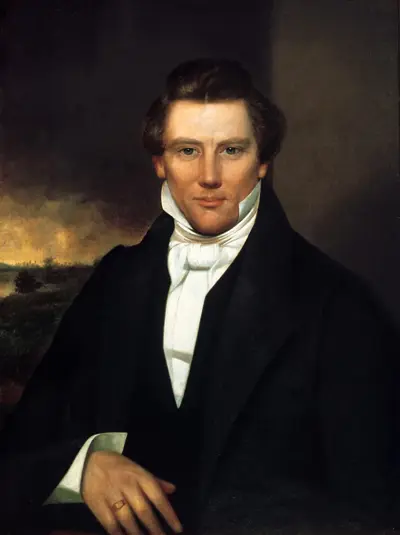
- Born: December 23, 1805
- Died: June 27, 1844
- Nationality: American
- Profession: Religious Leader
Joseph Smith, Jr. was an American religious leader and founder of Mormonism and the Latter Day Saint movement. When he was twenty-four, Smith published the Book of Mormon. By the time of his death fourteen years later, he had attracted tens of thousands of followers and founded a religious culture that continues to the present.
