Lewis Henry Morgan Quotes
Their whole civil policy was adverse to concentration of power in the hands of any single individual, but inclined to the opposite principle of division among a number of equals.
“Father of American Anthropology”
Lewis Henry Morgan, 1818-1881, Anthropologist Description of Colonial Iroquois Indian Society, 1851
Sourced by: Eigen's Political and Historical Quotations


Traditional political jurisdictional boundaries were geographic, but in one of the wisest decisions of English Colonial government, it was recognized that dealing with the Indians demanded a much different approach than the classic European extension of the Crown by appointing a Governor for a territory. As Superintendent of Indian Affairs, Johnson, had authority and responsibility for the Indians and relations with the Indians in Massachusetts and the other colonies, the Colonial Governor not withstanding. Bernard and the other Governors of course did not care for Johnson’s authority within his territory.


Although a conservative, he had many iconoclastic ideas. Almost all liberals and Democrats would agree with this quotation, but most conservatives and right wing Republicans support large concentrations of power in corporations and rich individuals.


See Woodrow Wilson for a contrasting view of power in America.


The “departments” refer the 3 branches of government: executive, legislative, and judiciary. The basic principle of the separation of powers (See {607920}) was fundamental to the state representatives at the 1787 Constitutional Convention, even though none of their state constitutions had accepted that principle.


Alberto Gonzalez, White House Counsel and later Attorney General who was forced to resign and David S. Addington, Counsel to the Vice President, had come up with a novel view of the powers of the presidency. They argued that since the President is the Commander in Chief, in a war situation or intelligence gathering thereto, has the Constitutional responsibility for that function, he need not obey any laws of Congress as in the conduct of the war Congress would be impinging on the Constitutional separation of powers which itself was prohibited by the Constitution. The argument did not find any significant legal support but for a while the George W. Bush White House behaved as if this were the law, despite the fact that even in the American Revolution and the War of 1812 Congress passed laws regulating the conduct of the armed forces as is provided for in other parts of the Constitution. Yet even Goldsmith would allow the President some powers that many think are unconstitutional and/or belong to Congress. See {32436}.
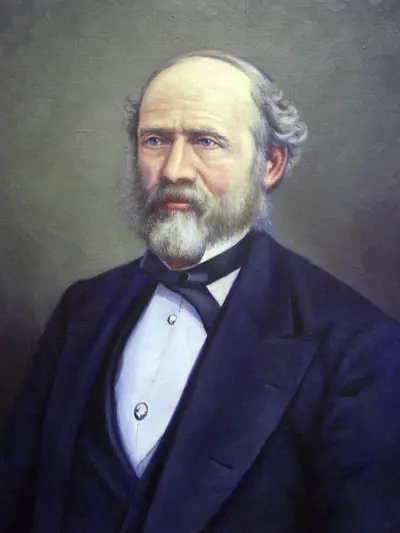
Lewis Henry Morgan was a pioneering American anthropologist and social theorist who worked as a railroad lawyer. He is best known for his work on kinship and social structure, his theories of social evolution, and his ethnography of the Iroquois. Interested in what holds societies together, he proposed the concept that the earliest human domestic institution was the matrilineal clan, not the patriarchal family.
