Karl Marx Quotes
The worker puts his life into the object; but now it no longer belongs to him, it belongs to the object.
Marx, Karl. Economic and Philosophic Manuscripts of 1844. Karl Marx, Frederick Engels: Collected Works, Vol. 3. International Publishers, 1975, p. 272.


The factory workers in Lynn, Massachusetts started their own newspaper: This was published four years before Marx and Engles published the Communist Manifesto


While it was true that wages did not increase beyond inflation, the enormous increase in productivity—about a doubling—was not only due to the workers but was also due to the capital investment that the companies made in computers, robots, job restructuring, advanced training, and other management initiatives. Historically, when there are substantial productivity increases, the benefit is shared between the workers and the company as both were necessary to produce the increase in productivity. But since 1980, the workers have not obtained any significant share of the productivity increase.

This quotation is important because so many modern conservatives regard Keynes as a Marxist economist. Those who do, generally have not read neither the one or the other—possibly neither.


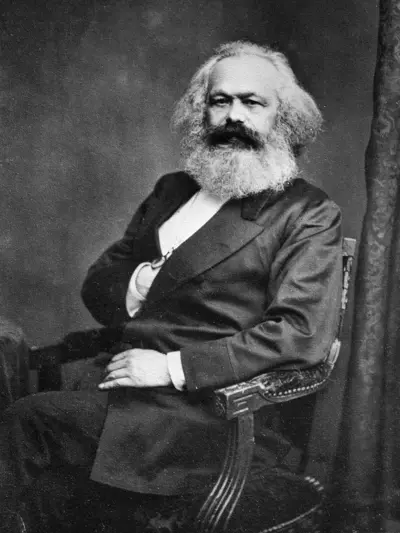
Karl Heinrich Marx was a German philosopher, economist, historian, sociologist, political theorist, journalist and socialist revolutionary. Born in Trier, Germany, Marx studied law and philosophy at university. He married Jenny von Westphalen in 1843. Due to his political publications, Marx became stateless and lived in exile with his wife and children in London for decades, where he continued to develop his thought in collaboration with German thinker Friedrich Engels and publish his writings, researching in the reading room of the British Museum. His best-known titles are the 1848 pamphlet The Communist Manifesto and the three-volume Das Kapital (1867–1883). Marx's political and philosophical thought had enormous influence on subsequent intellectual, economic and political history. His name has been used as an adjective, a noun, and a school of social theory.
