Donald Marr Nelson Quotes
The whole industrial strength of the United States, should it be directed to war-making, would constitute power never dreamed of before... It would be a struggle in which all our strength would be needed—and the penalty for being unable to use all our strength would be the loss of everything we have.
He has exactly right, but at the time there was much isolationist sentiment arguing against getting involved in “foreign wars”. To obtain the full industrial power of the United States, most of the manufacturing capability and raw materials would have to be taken from the civilian sector and devoted to military production. That would take men like Nelson, but primarily President Franklin Delano Roosevelt who would persuade the American people to make the immediate sacrifice to insure the future. See {642356} as an example.
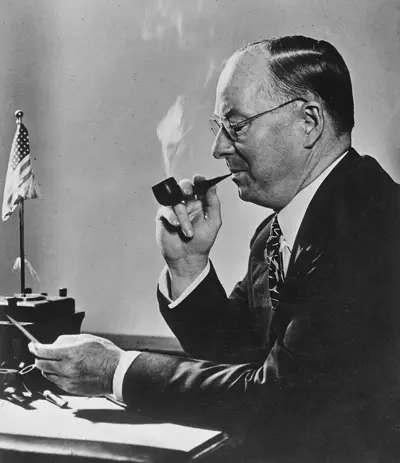
Donald Marr Nelson, 1888–1959, Chairman of the WWII War Production Board, Executive Vice President of Sears Roebuck, 1940
Sourced by: Eigen's Political and Historical Quotations


The Germans had invaded Russia who despite losing over 20 million people continued to fight the Germans who had never had to deploy forces over such a large territory. But it was the severe Russian Winter that turned the tide. Germans were not equipped or dressed for the terrible winter. The Russians were used to it. The Germans were repulsed and had to retreat back into Germany.

This is an interesting historical quotation because it shows how easily the United States commandeered private property during World War II. All it took was a letter from the Secretary of War. This particular quotation and letter had further historical significance. The school was acquired as the first facility for the Manhattan Project in Los Alamos. This was where the atomic bomb was built.

This historic speech is regarded as one of the most important in Australia's history, marking a turning point in Australia's relationship with its founding country, the United Kingdom. Many felt that Prime Minister Curtin was abandoning Australia's traditional ties to the British Isles. -- Wikipedia

The automobile assembly lines of Detroit, had been planned to be converted to factories to produce a huge supply of planes, tanks, trucks and guns which were instrumental in winning the Second World War.


1st Earl Baldwin of Bewdley. Though members of the same Conservative Party, Churchill was a major opponent of Baldwin’s peace and “appeasement” efforts and publicly castigated Prime Minister Baldwin. Yet Baldwin, if he could not stave off war, wanted his critic to serve as Prime Minister if war was inevitable. Churchill never had much respect for Baldwin. See {626930}.

Hebert was one of the first politicians to formally use the language of “Hawks” and “Doves” to publicly state his views on military matters.

Note that he assumes that not only will there be another World War, but he assumes that we will be on opposite sides.


The Germans did not believe the British would send land troops. See {642105}.


While Northern industry was one of the major factors of the Union winning the Civil War, it took some time to ramp up civilian-controlled production. This historical experience, and that of WWI (soldiers had to drill with brooms for rifles) were two of the major influences on President Franklin Delano Roosevelt to begin to produce arms and ammunition before we were actually at war. Preparedness has been an American policy ever since with even the Republicans who castigated FDR as a warmonger for spending money on the military in peacetime became the preparedness hawks and moved to the opposite end of the political spectrum on defense spending,

In WWII as later, defense contractors and military weapons designers were always trying to improve the design and proto-models, thus stalling production and utilization. Arnold’s statement galvanized the program and B-29s reached the Pacific theater to help win the war.


At the end of WWII there was much tension between Russia and the Anglo-American alliance. This plan was developed but never implemented. See {613195} for Prime Minister Winston Churchill’s description of the invasion idea.


- Born:
- Nationality:
- Profession:
Donald Marr Nelson (1888–1959) was an American business executive and public servant, serving as the executive vice president of Sears Roebuck before accepting the position of director of priorities of the United States Office of Production Management (1941–1942). In 1942 Nelson became chairman of the War Production Board (1942–1944) when it replaced the OPM. He later served for two years (1945–1947) as president of the Society of Independent Motion Picture Producers.
