Osami Nagano Quotes
Even if our Empire should win a decisive naval victory, we will not thereby be able to bring the war to a conclusion…. America will attempt to prolong the war utilizing her impregnable position, her superior industrial power, and her abundant resources. Our Empire does not have the means to take the offensive and make them give up the will to fight.
Osami Nagano, 1880-1947, Japanese Admiral, Statement to Japanese Emperor Hirohito, September 6, 1941
Sourced by: Eigen's Political and Historical Quotations

This historic speech is regarded as one of the most important in Australia's history, marking a turning point in Australia's relationship with its founding country, the United Kingdom. Many felt that Prime Minister Curtin was abandoning Australia's traditional ties to the British Isles. -- Wikipedia


He has exactly right, but at the time there was much isolationist sentiment arguing against getting involved in “foreign wars”. To obtain the full industrial power of the United States, most of the manufacturing capability and raw materials would have to be taken from the civilian sector and devoted to military production. That would take men like Nelson, but primarily President Franklin Delano Roosevelt who would persuade the American people to make the immediate sacrifice to insure the future. See {642356} as an example.


Women were needed in industry and the military. See {584783}.


1st Earl Lloyd-George of Dwyfor


This statement is perhaps the greatest and most eloquent description of the United States exceptionalism and its behavior in WWII. Such a statement could only come from a non-American.
She was referring to the aftermath of the Iraq War.

The German naval command—without the permission of the Kaiser—at the eve of a losing war decided that the entire German navy would make a grand attack against the far superior English fleet. It was to be a virtual suicide attack on a grand scale. However, most German sailors heard about the plan and refused orders to attack in what was the largest mutiny in history. The German naval leaders then took the fleet out to sea and scuttled all the ships so that the English would not capture them. The result was the same but tens of thousands of lives were saved; many German officers felt that German naval honor had been lost.

Note that he assumes that not only will there be another World War, but he assumes that we will be on opposite sides.
This has been true in just about every conflict. In WWII however, there were a highly disproportionate ration of atrocities with those of the axis forces dwarfing those of the U. S. and its allies. Further, after the war, those allied atrocities that did take place were published. In addition, one basic difference is in the policies of the fighting forces and their governments as opposed to individual actions by soldiers. In WWII, the allied atrocities were of the latter type, but the axis atrocities involved both.

Bethe and other European refugees joined American and British scientists at Los Alamos, NM, for the development of the atomic bomb.
This quotation is important because the American public and their leaders saw only one course of action—invasion of the Japanese Mainland. The debate was whether to attempt the invasion right away or bomb and blockade Japan into destruction and starvation weakening the population so their resistance would not produce the kind of casualties that we had experienced with the Invasion of Okinawa. The bombing and blockade strategy was selected and 80 percent of Tokyo was obliterated. Yet the Japanese refused to surrender even after all its manufacturing capability was destroyed and the agriculture was beginning to be destroyed. Most Americans did not realize it but the atomic bomb was being made ready for use. After the test bomb in New Mexico, we had enough fissionable material for 2 bombs and it would take several months for each additional bomb. The use of the atomic bomb at the time seemed not much different from the massive bombing that had already taken place. More Japanese were killed in some of these conventional bombings than with the Atomic Bomb. The key believe was that the Japanese would not give up. After the first A bomb, they still would not surrender, and when the Emperor decided on surrender after the 2nd bomb, there was a military insurrection in the palace to stop the Emperor’s surrender message to the people from being broadcast. It was just minutes too late, and the Emperor had to be obeyed. Invasion, with its terrible casualties—many more than the atomic bombs—was unnecessary.
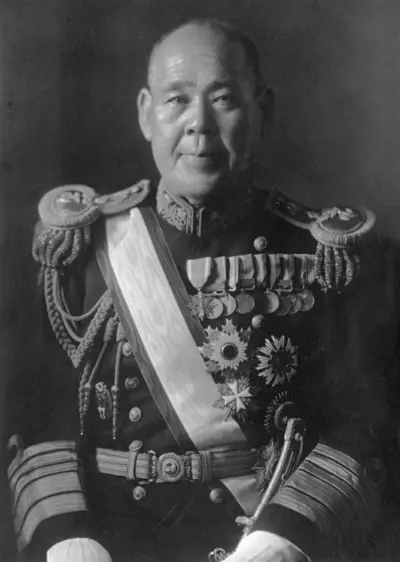
Osami Nagano was a Marshal Admiral of the Japanese navy and one of the leaders of Japan's military during most of the Second World War. In April 1941, he became Chief of the Imperial Japanese Navy General Staff. In this capacity, he served as the navy’s commander-in-chief in the Asia-Pacific theater until his removal in February 1944. After the war, he was arrested by the International Military Tribunal for the Far East but died of natural causes in prison during the trial.
