Hyman Rickover Quotes
The Three Mile Island Report to President Carter, if published in its entirety, would have destroyed the civilian nuclear power industry because the accident at Three Mile Island was infinitely more dangerous than was ever made public.
Rickover, the father of the nuclear submarine was not only an expert in nuclear reactors and power, but he was known as a safety perfectionist with a safety record in the Navy that is still marveled at. President Carter, as a naval officer, had worked for Rickover and himself was technologically knowledgeable about nuclear power. He asked his old mentor to chair the investigating the Three Mile Island incident. Rickover actually recommended to the President that much of the report be secret, assuming that reform would take place quickly if the nuclear power industry were not killed by the damning expose of inept personnel and the lack of safety processes with a very dangerous process. However, few reforms were made nationally, and Rickover, 6 years later, grew to regret his recommendation for secrecy.
Hyman Rickover, 1900-1986, U. S. Navy Admiral, "Father" of the nuclear submarine, Statement to his Daughter-in-Law, Jane Rickover, May 1983
Sourced by: Eigen's Political and Historical Quotations


During the meltdown of the Japanerse nuclear reactors at Fukashima, American sailors were deployed to provide critical assistance fram an American aircraft carrier in the area. They played a significant role in getting the reactors under control. Many of the Japanese at the emergency area had suffered serious illness from the radiation exposure abd a number died. The crew of the aircraft carrier had developed a highly unusual prevelance of serious illness assocated with radiation exposure. The U. S. Defense Department was "styding the matter" but had not decided that the unusual illness patern was related to their assignment assisting in th emergency. A number of the sailors had come to japan and asked for damages from the Raactor company which like most American Corporations would not do or say anything. The Japanese government also was silent on the issue when the sailors came to Japan, However, this former prime minister felt so strongly that he visited the Sailors and took up their cause in letting the Japanese public know what had happened and how the government and the electic company were acting. This was Koizumi's tearful response to the press covering the saolors and their request.


Rocky Flats was operated for the government by Dow Chemical Company, which unfortunately violated the terms of their contract and improperly buried nuclear waste which ended up producing so much radiation that the plant had to be closed down and the government had to buy up property around the nuclear plant as a buffer zones so that private people would not receive high radiation doses by being too close to the plant.


There had been so much nuclear activity—military and civilian—that he thought it inevitable, either by intention or accident, that there would be some catastrophes. Chernobyl and the crash of a nuclear bomb equipped plane in Spain destroyed the two areas for years thereafter proved him prescient but fortunately none of the “incidents” were bad enough to affect millions of people significantly although the damage of Chernobyl is still being discovered.

Corporations in the nuclear business argue that Nuclear power is less expensive than otehr forns of ower that are in common use. However, when a nation adds the huge cost of maintianing a scientific infrastructure to inspect and regulate the nuclear power plants, and the costof establishing the contingency capability of popularion evacuation and containment when there is a nuclear accident, and then the cost of safely stopring and containing the spent but deadly radioactive fuel, the incredibly high cost of insurance, then it is clear that nuclear power is the most expensive form of power. However, some countries do it better than others with France being the only country at the beginning of the 21st century that operated nuclear power safely and efficiently. The United States, Russia and Japan had huge costs


There have been dozens of serious nuclear accidents almost all of which were withheld from the public and even many of the civilian scientists who were trying to make the bombs error proof, but who did not know the details of the kinds of human errors that were being committed. The motivations for the secrecy were multiple. There was the usual one of saving the military from embarrassment which is typical throughout the government where they have the right to classify information. But another reason was the military leaders did not want the civilians to regain control. See {637984}. Perhaps most important, they did not want to provide ammunition for the anti-nuclear movement to have the incidents with which they could scare the public and erode public support for a large nuclear weapons program.

He was speaking from retirement. When he was Prime Minister--2001-2005, and active politically, he was in favor of nuclear power for Japan. But after the meltdown of the reactors at Fukishima, he saw happening exactly what the corporation executives running the nuclear power told him could never happen. He aslo supported the claims of American Sailor who had provided much help in the nuclear emergency that they were suffering from deseases brought on by teh excessibe radiation that they encountered.

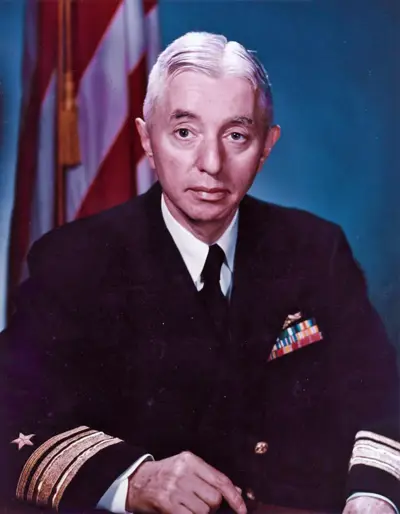
Hyman G. Rickover was an admiral in the U.S. Navy. He directed the original development of naval nuclear propulsion and controlled its operations for three decades as director of the U.S. Naval Reactors office. In addition, he oversaw the development of the Shippingport Atomic Power Station, the world's first commercial pressurized water reactor used for generating electricity. Rickover is also one of four people who have been awarded two Congressional Gold Medals.
