Eugene Scalia Quotes
The SEC and CFTC are expert agencies blessed with immensely capable professionals. Judges value and defer to that expertise - when it's exercised to make the hard decisions that Congress entrusts to an agency.
Scalia, Eugene. "A Court Restores the Rule of Law at the SEC." The Wall Street Journal, 23 Jul. 2011.


The Consumer Finance Protection Bureau was established over much Conservative opposition in the reforms that were established in the wake of the Meltdown of 2008 and the Great Recession. And the Republican Party was critical of everything that it did. The issue of whether or not the Federal government should even have a role in consumer protection was been debated for over a century. This quotation is very ironic in that the first major federal legislation to assist American consumers was pushed though by Republican President Theodore Roosevelt. Over 100 years later, it was the Republican Party that fought to weaken or eliminate Federal efforts. Ryan, the Republican legislative leader, led the effort. Ironically, most businesses agreed with him about the micromanagement as it was they who had to change their modes of operation to comply with CFPB regulation, but the vast majority of consumers did not feel that they were being micromanaged although many agreed that the companies interacting with consumers were certainly being managed much more tightly.


Criticizing federal regulators in the 1989 Savings and Loan scandal:
All three of the credit rating agencies gave securities of bundled very risky mortgages the highest and most secure ratings. They never examined the underlying securities, and continued to give these AAA ratings even after many had defaulted and they were in “junk bond” status. The rules then were that the financial companies who wanted a rating would “discuss” the rating that they would get BEFORE they paid the rating companies to do the rating. In no case did they ever pay a rating agency for a rating unless there would be a AAA rating despite the fact that these securities were among the highest risk public securities in American financial history. Under the law at the time, the rating agencies could not be held liable for there irrational ratings.

More than 20 years later, after unregulated finance enabled the Great Depression, Franklin Delano Roosevelt, finally got the Securities and Exchange Commission passed by Congress. By the beginning ot the 21st century

Marcopolos had discovered the Bernie Madoff Ponzi scheme fraud 9 years before the government discovered the largest consumer fraud ($68 billion) in American financial history. He repeatedly sent warnings and explanations to the SEC investigators, most of which turned out to be exactly right. They ignored all of it, and never investigated Madoff to see if there might be anything amiss.

Greenspan and some others assumed that the shareholders and the executives who ran the financial institutions had the same vested interests. But the executives had disconnected themselves from the fate of the shareholders, by having Golden Parachutes to protect the executives even if the business failed and they were fired. And they got their bonuses immediately so by the time the authorities and the shareholders discovered that the profits the bonuses were paid for were illusory, the bonus money was safely stored in a secret offshore bank. But if things went wrong, there was always the play of getting a government bailout which would keep the executives getting their huge bonuses and keep the shareholders from losing their money as the taxpayers covered most of the losses.
Modern finance is so complex and convoluted, that any laws or regulations that government makes are quickly evaded by even more complex and convoluted schemes which the legislators and regulators have to try and control. By the time they learn and understand and finally develop measures to regulate those, the cycle starts again. Hence the “fool’s errand”


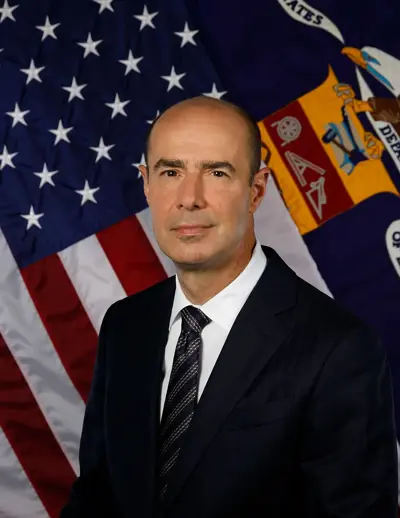
Eugene Scalia is an American politician and attorney who served in the Donald Trump administration as the 28th United States Secretary of Labor, from September 30, 2019 to January 20, 2021. He was formerly a partner in the Washington, D.C. office of the law firm Gibson, Dunn & Crutcher; and previously served one year as Solicitor of the Department of Labor during the George W. Bush administration. He is a son of the late Supreme Court Associate Justice Antonin Scalia.
