Abu Abdullah Muhammad Ibn Battuta Quotes
The rulers, scholars, officials and big merchants as well as the port workers, farmers, craftsmen, and slaves, were dark-skinned people speaking African tongues in everyday life
Although Mogadishu was Muslim, Blacks were in total control and not Arabs.
Abu Abdullah Muhammad Ibn Battuta, 1304-1377), Moroccan Berber Traveler & Explorer, Description of Mogadishu, Rihla [Travels]
Sourced by: Eigen's Political and Historical Quotations

Adams was the lawyer who defended the British troops of the Boston Massacre. He described the crowd as:


Harris opened up trade with Japan for the United States. The problem at the time had nothing to do with the potential economic effects of trade on domestic industry or balance of payments, but for the Japanese was strictly a cultural problem. They were in great fear of what today some call “cultural imperialism”--the adoption of a foreign culture. The Japanese had been so fearful of cultural influence of foreigners that when some Japanese fishermen’s boat had been sunk and they had been rescued by foreign seamen and returned to Japan, they were executed as they had been “contaminated” and could “contaminate” the rest of the population.


Islam is a proselytizing religion, and the Wahabi sect that dominates the religion and even the Royal Family in Saudi Arabia, is a particularly fundamentalist exponent. Hence the translation of Islamic books into Arabic. The few books translated into Arabic reflects not only the fear of heresy and cultural imperialism, but there is a conservative Islamic view that everything that is valid and important to know is in the Koran and the Hadith. Therefore, no other books are necessary.
Many Irish use the term “race” in a cultural sense. To them, the Irish are a different race from the English or the Italians.

Over the years, despite many efforts to unify workers of the world, most were much more focused on their own country. In this sense, Mussolini who was so wrong about most political things, may have been right in this instance.

He was pushing the idea of getting the poor and destitute of England to go to the American colonies where a labor force was needed. “Fry” was a term for offspring — children.


There was an interesting parallel to the Iraq and Afghanistan Wars. When American troops would explain their mission to locals, many were actually fearful of terms like democracy, freedom, education, development and modernity. Religious and cultural forces had made these concepts fearful and undesirable and while there were many who saw these as desirable, there were also many who perceived these as undesirable and even evil. The American military faced the same problem a century ago.

This editorial from an Alabama newspaper in 1856 is a wonderful illustration of the animosity held by many in the South towards the North. It also shows the major difference in egalitarianism between the North and the South at that time. The only Southerners who could read were the upper class who were terribly fearful of the effects of upward mobility of whites in a slave free industrial democracy. “Mechanics” at the time referred to all skilled craftsmen.
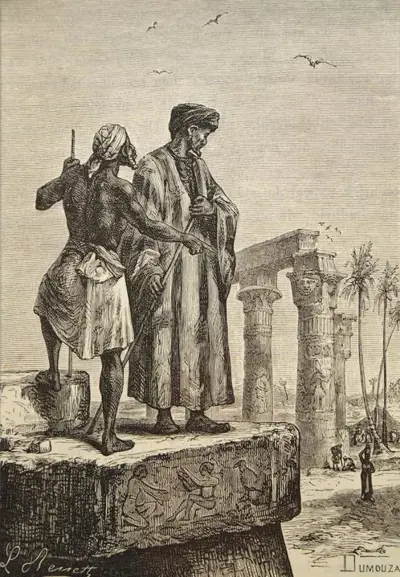
Ibn Battuta was a Muslim Berber-Moroccan scholar, jurist and explorer who widely travelled the Old World, largely in the lands of Dar al-Islam, travelling more than any other explorer in pre-modern history, totalling around 117,000 km (72,000 miles), surpassing Zheng He with about 50,000 km (30,000 miles) and Marco Polo with 24,000 km (15,000 miles). Over a period of thirty years, Ibn Battuta visited most of the Old World, including Central Asia, Southeast Asia, South Asia, China and the Iberian Peninsula. Near the end of his life, he dictated an account of his journeys, titled A Gift to Those Who Contemplate the Wonders of Cities and the Marvels of Travelling, but commonly known as The Rihla.
