Ismail Serageldin Quotes
The public does not necessarily want to hear, much less to act on unsettling or disturbing findings… censorship can be, and is frequently supported by the majority of the population.
Islamic modernists like Serageldin are many among the educated Muslims but their views are often drowned out by the violence and extremist statements of the fundamentalists.
Ismail Serageldin, Egyptian Director of the Library of Alexandria & Historian, Member of the Egyptian Senate & World Bank Enviornmental VP & World Bank Enviornmental VP & World Bank Enviornmental VP, Speech, Oslo, Norway, June 4, 2009
Sourced by: Eigen's Political and Historical Quotations

He was concerned about the possible “tyranny of the majority.”


1st Baron Lytton of Knebworth


This was much more the case in 1840 when this quotation was written. Since then, a much higher proportion of American society has become educated, and the cultures that American immigrants have come from had multiplied. Publications abounded and after radio and television there were more attacks on American majority positions. The major change came with radio call in talk shows, similar TV shows and then the Internet provided a painless way to publicly go against majority opinion. By the first decade of the 21st century, movements of majority rejectionists such as the Tea Party and the Occupy Movement were thriving and “futile contests” received much public attention and showed that there were others with the non-majority views who made it socially acceptable to be outside the norms of the majority.

The important thing about rights is that they exist independent of majority opinion. The majority might want to trample the rights of an unpopular group or individual. Very often Islamic modernists like Serageldin are many among the educated Muslims but the majority views are often drowned out by the violence and extremist statements of the fundamentalists.

The Red Scare had affected much of the country. Congressman Thomas was the Chair of The House Un-American Activities Committee which had frightened much of the country claiming that the Communists had infiltrated the government. But when facts and proof were demanded, they came up with some workers in the Hollywood film industry who had gone to communist meetings and some who had joined the party before the War when The Great Depression was still plaguing the country. The Hollywood and TV executives caved in to the political demagogues and fired and blacklisted not only the communists but those who refused to testify. The actors and musicians could not work for several years until the country came to its senses, but the screenwriters wrote under false names. At least one Academy award was won that way.


Madison wrote this essay for publication in New York. That state, one of the largest and most important of the 13 colonies, was polarized about the proposed Constitution and Madison, Hamilton and John Jay produced this great set of essays to convince Americans to vote for ratification. Madison acknowledged that many people had complained about various aspects of the proposed constitution and in this essay he deals with the complaints about political parties—“factions”.
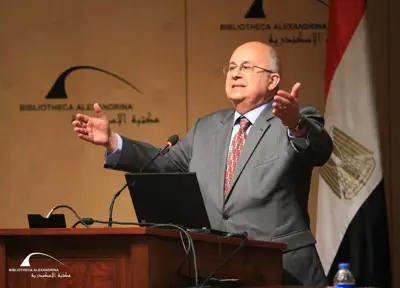
Ismail Serageldin (/ˈsɛrəɡɛldɪn/; born 1944 in Giza, Egypt), Founding Director of the Bibliotheca Alexandrina (BA), the new Library of Alexandria, inaugurated in 2002, is currently, Emeritus Librarian, and member of the Board of Trustees of the Library of Alexandria. He serves as Chair or Member of a number of advisory committees for academic, research, scientific and international institutions and civil society efforts, including as co-Chair of the Nizami Ganjavi International Center (NGIC), and serves on the Advisory Committee of the World Social Science Report for 2013 and 2016, as well as the UNESCO-supported World Water Scenarios (2013) and the executive council of the Encyclopedia of Life (2010) and Chairs the Executive Council of the World Digital Library (2010). He also co-chaired the African Union's high level panel for Biotechnology (2006) and again for Science, Technology and Innovation (STI) in 2012–2013, and was a member of the ICANN Panel for the review of the internet future (2013).
