Ismail Serageldin Quotes
How do we protect free speech, when it may well be seen by the majority of the population as something that undermines the “just requirements of morality, public order and the general welfare…? Legislating against free speech is always dangerous. Worse, in some countries and contexts, lawsuits have been used to harass those who hold dissenting or contrarian views.
The important thing about rights is that they exist independent of majority opinion. The majority might want to trample the rights of an unpopular group or individual. Very often Islamic modernists like Serageldin are many among the educated Muslims but the majority views are often drowned out by the violence and extremist statements of the fundamentalists.
Ismail Serageldin, Egyptian Director of the Library of Alexandria & Historian, Member of the Egyptian Senate & World Bank Enviornmental VP & World Bank Enviornmental VP & World Bank Enviornmental VP, Speech, Oslo, Norway, June 4, 2009
Sourced by: Eigen's Political and Historical Quotations

This is a typical statement of human rights policy by many countries. Essentially, some controlling authority states that rights are guaranteed except when it is “dangerous” or contrary to the country’s “best interest”. Of course then anything the authorities want to censor is classified so that it is an exception. To be a right, it must be guaranteed even when hateful, insulting and/or dangerous.


Those who wanted to restrict freedom of speech during World War I argued that the popular will could express itself during elections:


Islamic modernists like Serageldin are many among the educated Muslims but their views are often drowned out by the violence and extremist statements of the fundamentalists.

Samuel Langhorne Clemens, 1835-1910. Even when we have political freedom of speech, there are often social consequences to exercising that freedom. See {630273} .


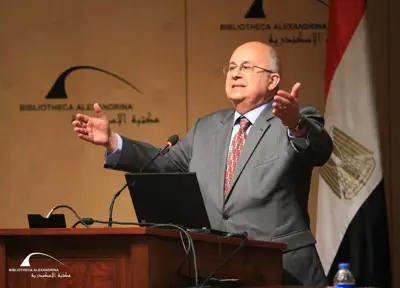
Ismail Serageldin (/ˈsɛrəɡɛldɪn/; born 1944 in Giza, Egypt), Founding Director of the Bibliotheca Alexandrina (BA), the new Library of Alexandria, inaugurated in 2002, is currently, Emeritus Librarian, and member of the Board of Trustees of the Library of Alexandria. He serves as Chair or Member of a number of advisory committees for academic, research, scientific and international institutions and civil society efforts, including as co-Chair of the Nizami Ganjavi International Center (NGIC), and serves on the Advisory Committee of the World Social Science Report for 2013 and 2016, as well as the UNESCO-supported World Water Scenarios (2013) and the executive council of the Encyclopedia of Life (2010) and Chairs the Executive Council of the World Digital Library (2010). He also co-chaired the African Union's high level panel for Biotechnology (2006) and again for Science, Technology and Innovation (STI) in 2012–2013, and was a member of the ICANN Panel for the review of the internet future (2013).
