Matilda Joslyn Gage Quotes
The protection of the writ of Habeas Corpus is denied married women in every State of this Union, notwithstanding the Constitution of the United States declares it shall not be suspended except when, in cases of rebellion or invasion, the public safety demands it.
Matilda Joslyn Gage, 1826-1898, Suffragette, Abolitionist & Historian, Ballot Box, Toledo, Ohio. November 1876
Sourced by: Eigen's Political and Historical Quotations

“Political correctness” is a loosely defined concept of not discussing political issues in terms that are derogatory and/or might be offensive to particular groups or nationalities. Many orthodox Muslims (and orthodox Christians) are of the opinion that their religion calls for the male being the dominant figure in the household and having the right and obligation to discipline the children and the wife or wives. To state that such a practice is sexist, barbaric, undemocratic, and damaging to family and society is an insult to some of these religious believers. The Egyptian law was passed to reflect God’s commandments and so to question it is to some, blasphemous and for other nations to criticize it is insulting to some ultra orthodox Muslims. However, in cases like these, Ms. Eltahawy argues for ignoring political correctness and most Americans would agree as would most of the modern and generally educated Muslims in Egypt.


Women were not, in the decisions of Canadian courts “Persons.” As such they were not allowed to serve as public officials and legislators. In 1929 the Judicial Committee of the Privy Council reversed previous interpretations and declared women eligible for all public offices. It became known as “The Persons Case.” Murphy then wrote her argument. Murphy wrote serious non-fiction under her own name and novels under the pseudonym Janey Canuck.


In English law, the second a woman married, she ceased to exist and an entity independent from her husband who had total control in the family. This doctrine was carried over to American law. See {629246}.


Vladimir Lenin

She was prescient. The amendment was never ratified by enough states.


This statement is referring to the custom of women covering their eyes whenever a man who they did not know passed them. Turks did not ever use Burkas the way some other Muslim countries do, but they wore headscarves and covered their eyes when a strange man appeared. This was a shocking statement in a sexist Islamic culture. Although the process of modernization and reform in Turkey was relatively bloodless, Ataturk was prepared to and did use force to defend it. This and many others made the role of women not only uniquely equal in the Islamic world, but women were suddenly elevated to the level of most Western nations and in voting rights were ahead of most. He used his own family to set an example. See {584503}.


The deed was made out in the name of her husband followed by the phrase “et ux”. That is a legal abbreviation for “et uxor” which literally means “and wife”. It was in use in English and American law from the time that married women had no right to property and the wife was a mere appendage to the husband. It is still recognized as a proper form by the law of many states.

This was the infamous opinion whereby the Supreme Court upheld the “separate but equal” doctrine thereby preserving racial discrimination until the reversal over 50 years later. See the sole dissent of Justice John Marshall Harlan whose views were those that eventually prevailed although at the time all the other justices voted with the majority. See {583706} and {583703}.
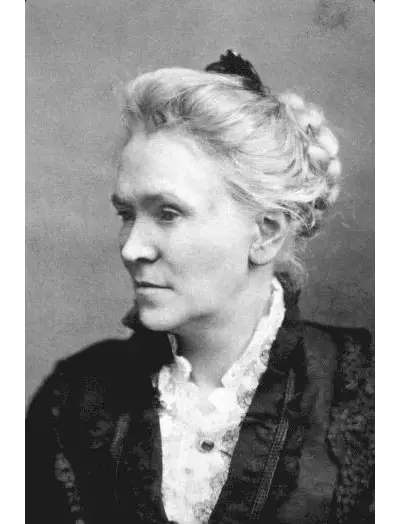
Matilda Joslyn Gage was a women's suffragist, Native American rights activist, abolitionist, freethinker, and author. She is the eponym for the Matilda Effect, which describes the tendency to deny women credit for scientific invention.
