Stephen H. Long Quotes
The plains are almost wholly uninhabitable by people depending upon agriculture.
Stephen H. Long, 1784-1864, Soldier, Engineer and Explorer, Description of the Great Plains that he had been exploring, 1820
Sourced by: Eigen's Political and Historical Quotations

This was the first use of the term “dust bowl”. Its stock and within years it was used by almost everybody describing the Great Plains.


For "The pen is mightier than the sword," see Bulwer-Lytton


Ransome had a unique access to Post Russian Revolutionary leadership as his fiancée was the secretary to key Russian Communist party committees and through her he had access to Lenin, Trotsky and other leaders. In general Ramsome is best known as a children’s book author.
The Diggers were a religious-economic movement that even today would be considered very radical. They advocated the right of the poor to go onto public lands and farm them—thus the name “Diggers.” Beyond their opposition to the private ownership of land to the exclusion of the poor, Winstanley and the Diggers promulgated another very modern doctrine: That the poor should take the responsibility and have the right to determinine how the society should provide for the poor. A version of this became one of the Mottos of the Poverty Program of 1964. See {616966}.

The Depression had 25% unemployment and many people lacked even food to eat. Meanwhile, there was a huge amount of unused, idle land in California.


Clinton was a founder of the society. In his view, and that of many others, this was the essential problem facing the Indians and whites in North America. It was also a problem between agricultural Indian tribes and those that were hunter-gatherers. The whites of the time were predominantly agriculturalists. The hunter gatherer requires much more land per person than does the farmer. Agriculture allowed progress and development, but at the same time, it curtailed and eventually ended hunter-gatherer cultures nearby. Over time, the latter either became agricultural communities or degenerated and/or disappeared.

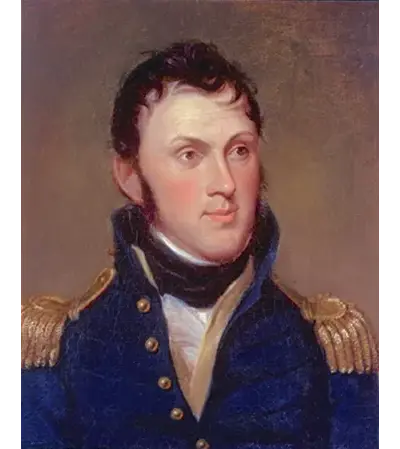
Stephen Harriman Long was a U.S. Army civil engineer, explorer, and inventor. As an inventor, he is noted for his developments in the design of steam locomotives. He was also one of the most prolific explorers of the early 1800s, although his career as an explorer was relatively short-lived. He covered over 26,000 miles in five expeditions, including a scientific expedition in the Great Plains area, which he famously confirmed as a "Great Desert" (leading to the term "the Great American Desert").
