Rutherford B. Hayes Quotes
The party out of power gains by all partisan conduct of those in power.
This is a fascinating quotation in that it was true in Hayes’ tenure and at other times in American History, but at other times it was not at all the case. Two notable examples were the administrations of Thomas Jefferson and those of George W. Bush. Voters claim to not like partisanship but in many eras they do not punish the majority for their lack of bipartisanship.
Rutherford B. Hayes, 1822-1893, 19th President of the United States (Republican, OH), Diary Entry
Sourced by: Eigen's Political and Historical Quotations

In a zero sum system whenever one party gains, the other must lose, and if one loses, the other has a corresponding gain. At other times, legislation was not a zero sum game. Many Congressmen believed that if good legislation would be passed, BOTH parties would benefit as would the country. If poor or no legislation were passed, that would be bad for all.

The prime minister had suggested that the Queen make a State Visit to Ireland. However, such an event would dominate the press and be advantageous to the majority party which was under public criticism for other matters. Queen Victoria did not want State visits or other events involving the crown to be used by the party in power as it might make the Irish feel the visit was not sincere and was simply undertaken for partisan political advantage. However, Victoria did want to try and improve relations with Ireland and suggested a visit later. She was also concerned that some right wingers of the majority party would claim that the reason she was not making the visit was for fear of adverse Irish reaction. There were constant difficulties regarding the degree of Irish autonomy and this was always a potential risk. However, the Queen would not let her position be used for political advantage and postponed the visit. This should be contrasted with the American system where the President is both head of state and head of government and often will undertake a state function for partisan advantage. There is often criticism from the other party, who would prefer the non partisanship of the English crown—until their party wins the Presidency at which time, they too use state functions for political advantage.


Most American politicians and citizens, unlike DeLay, believe that arguing against the opponents’ political philosophy should be done with debate, civil argument, advocacy, speechmaking and writing and not by attacking opponents and confronting them whenever possible. Later, DeLay was convicted and sentenced to jail for money laundering and illegally spending and raising campaign funds. He was also reprimanded by the House Ethics Committee for unethical methods of fund raising for other earlier actions.

The Republicans had been badly beaten in the 2012 Presidential Election. Many attributed the loss to the dissatisfaction of the electorate with the Republican ideas which had become more and more conservative in recent decades. Others, like Rubio, wanted to maintain the existing ideas which were very different from the Republican ideas earlier when they won more elections.

At the time Congress was gridlocked in bitter hyperpartisan conflict. Most people called for more comity and bipartisanship and most politicians wanted more bipartisanship but blamed the other party for the rift. Mourdock,arguing for less bipartisanship and no compromise defeated Richard Lugar in the Republican Senatorial Primary election. Lugar, one of the most respected and effective Senators was a statesman who worked with any and all to find effective compromises to reach national solutions. The nation was so politically polarized that the Republican Indiana voters ousted one of their most senior senators because he was effective at developing national solutions. See {626717} and {302706} for other Mourdock outrageous comments. While this rhetoric won in the Primary, it lost him the general election in a state where Republicans had a strong majority and should have had the seat.
At the time Congress was gridlocked in bitter hyperpartisan conflict. Most people called for more comity and bipartisanship and most politicians wanted more bipartisanship but blamed the other party for the rift. Mourdock, arguing for less bipartisanship and no compromise defeated Richard Lugar in the Republican Senatorial Primary election. Lugar, one of the most respected and effective Senators was a statesman who worked with any and all to find effective compromises to reach national solutions. The nation was so politically polarized that the Republican Indiana voters ousted one of their most senior senators because he was effective at developing national solutions. See {626717} and {302706} for other Mourdock’s outrageous comments. While this rhetoric won in the Primary, it lost him the general election in a state where Republicans had a strong majority and should have had the seat.


In 1873 there was a national debate of a proposal to create a government endowed and operated "National University:"

The Republicans who won control of Congress in 2000 with a Republican President had campaigned on the principle of smaller government and no deficits. In the next 8 years they spent more than any Congress in history and twice as much as President Clinton had in the previous 8 years not counting military spending and entitlements which were much greater.


This appears to be the first time in American history where the losing opposition did not at least claim that they wanted to work with the elected president to better the country. In this case, the partisanship was so bad that the major goal of the Republicans was to do what they could to have the president fail in his first term. To achieve their objective, the Republicans opposed almost every presidential legislative initiative of Obama’s including those that they had supported in previous ones. In several cases, the President proposed to accept previous Republican programs and ideas, and must Republicans then voted against the proposal so that they could deny the president any legislative success even if it moved the Republican programmatic agenda ahead. The Strategy worked in the sense that that Congress passed fewer bills that any in history, but failed to keep Obama from a second term. While the voters were not happy that the President was not able to persuade the Republicans to compromise and pass needed legislation, enough of them realized that the Republicans were more responsible, and reelected the President. The constant opposition to anything Obama advocated and the drumbeat of accusations against him drove his public approval numbers way down. In the process the Republicans drove their own approval percentage under 10 percent. The Republicans followed McConnell’s leadership, hurt the President badly, hurt themselves worse, and hurt the country.

The historian was comparing Obama to other historical presidents who either had a majority of both Houses of Congress or had an opposition party that was generally quite cooperative and willing to compromise for the sake of running the country smoothly. At this point in time there was a Tea Party wing of the Republican that was particularly negative and obstructionist. They tended to threaten and intimidate the main stream Republicans who used the filibuster to block legislation the majority of Senators had voted for more times than all the other Congresses in American history. And that was only in Obamas first 6 years.


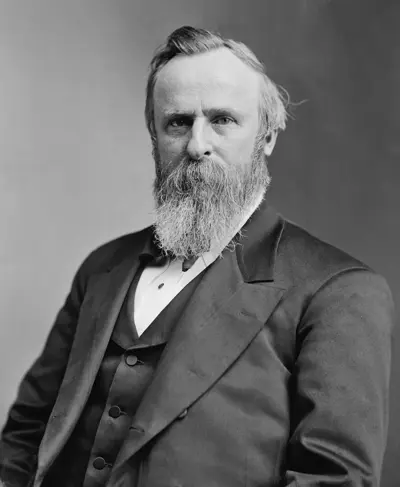
Rutherford Birchard Hayes was an American politician and attorney who served as the 19th president of the United States from 1877 to 1881, after serving in the U.S. House of Representatives and as governor of Ohio. A lawyer and staunch abolitionist, he had defended refugee slaves in court proceedings during the antebellum years. He negotiated the political agreement to end federal support of Reconstruction.
