Kurt Vonnegut Quotes
The most racist, nastiest act by the USA, after human slavery, was the bombing of Nagasaki. Not of Hiroshima, which might have had some military significance. But Nagasaki was purely blowing away men, women, and children.
Vonnegut, Kurt. A Man Without a Country. Seven Stories Press, 2005.


Alvarez was a scientist who worked on the Manhattan Project developing the atomic bomb:

Although generally a right wing conservative, Clark today sounds like almost like an extreme leftist on the issue. At the time however, many thought that he had taken leave of his senses. He not only was completely contrary to bipartisan national policy but opposed by almost universal American public opinion. He is one of the very few significant American officials to oppose the war policies.

On March 9-10, 1945, over three hundred B-29 Superfortresses, loaded with 2,000 tons of incendiary bombs flew over Tokyo bombing the city in waves for 6 hours. Over 250,000 buildings were destroyed and more people killed than would be in either Hiroshima or Nagasaki which were destroyed by atomic bombs. The fact that the Japanese would not surrender even after such complete destruction of their capital and largest industrial city, was used by American leaders in assessing whether to use the atomic bomb afterwards. There were many who believed that the atomic bomb would not be enough for motivate a Japanese surrender as Japanese culture prohibited surrender. Indeed, even after the 1st atomoc bomb, the Japanese did not surrender, and after the 2nd, the war council was split 3-3 and the Emperor historically broke the tie. Even the atomic bomb might not have worked. Later generations found this resistance to surrender hard to understand but Japanese culture was amazingly strong then.


Fermi was the scientist who organized and planned the first controlled nuclear chain reaction as a part of the Manhattan Project and was one of the major scientific advisors to the Atomic Energy Commission until he, Oppenheimer, and several other scientists opposed the development of the Super (the name Edward Teller had given to the proposed hydrogen bomb). The scientists knew that we had and could make enough atomic bombs to destroy any nation and to make it doable with just a few bombs as opposed to many they saw as of little military
value. They further expected that the Russians and some others would be forced to keep up with us in an arms race and that the bomb would never be able to be used without retaliation in kind and the destruction of most of America. The politicians and military did not really believe that the Russians had the scientific capability to develop hydrogen weapons and some thought if we had them and no one else did, we could dictate a “pax Americana” to the world. Others feared that Russia or some other country would develop a hydrogen weapon and then dictate to us. We did have a monopoly on the Super for a few years and America never dictated to the rest of the world. When other countries developed the weapons, we entered the era of Mutually Assured Destruction (MAD).

This may have been one of the most indelicate and insensitive true public statements ever made by a politician. The English population and their political representatives were angry and worried very much that bombing of cities might become a German pattern (which it did.)


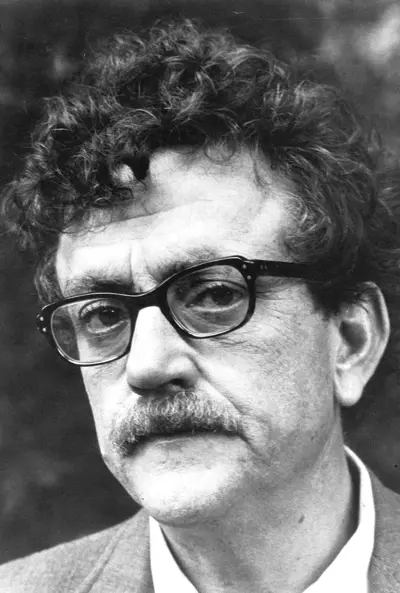
Kurt Vonnegut Jr. was an American writer. In a career spanning over 50 years, he published 14 novels, three short story collections, five plays, and five nonfiction works, with further collections being published after his death.
