Isaac Newton Quotes
The monarchy of the Greeks for want of an heir was broken into several kingdoms; four of which, seated to the four winds of heaven, were very eminent. For Ptolemy reigned over Egypt, Lybia and Ethiopia ; Antigonus over Syria and the lesser Asia; Lysimachus over Thrace ; and Cassander over Macedon, Greece and Epirus .
Newton, Isaac. Observations upon the Prophecies of Daniel, and the Apocalypse of St. John. J. Darby and T. Browne, 1733, p. 116.


Pasha Muhammed Ali was the Ottoman Overlord of Egypt and Syria. He is an unusual example of a leader who was a realist relative to the skills and abilities of his family for succession. His family indeed could not hold Egypt.

Khomeini was a politician as well as a cleric. He was not always consistent depending on his audience. This book was the publication of 17 different speeches with different audiences. Here he opposes all monarchy, but there is little doubt that his main target was the monarchy of Saudi Arabia. In {620335} he suggests that monarchy would be acceptable if the monarch followed Islamic law. Here he leaves no room for monarchies of which there were and are a number in the Muslim world. And at the height of Islam there was a Caliph who not only had absolute rule of ALL Muslim countries, but he was the absolute ruler of the religion. The Caliph and later the Islamic Sultan held more absolute power than any king or Pope ever had. Most of the Islamic fundamentalists claim that they want a return to having a Caliph with absolute power. And even in Iraq today, the “Supreme Leader” exercises more autonomous power, than any monarch or dictator does in his own country.


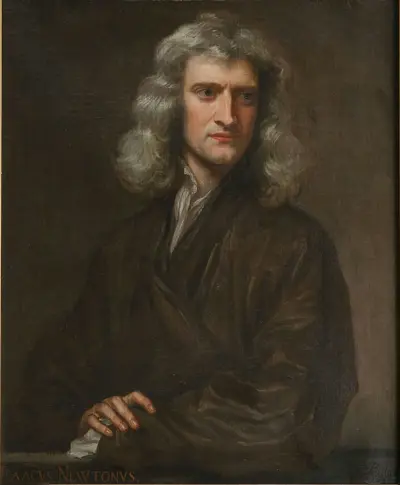
Sir Isaac Newton PRS was an English mathematician, physicist, astronomer, theologian, and author (described in his time as a "natural philosopher") who is widely recognised as one of the greatest mathematicians and most influential scientists of all time and as a key figure in the scientific revolution. His book Philosophiæ Naturalis Principia Mathematica (Mathematical Principles of Natural Philosophy), first published in 1687, established classical mechanics. Newton also made seminal contributions to optics, and shares credit with Gottfried Wilhelm Leibniz for developing the infinitesimal calculus.
