Tariq Ramadan Quotes
The problem with what we call the 'Arab spring' is that these are very nationalistic experiences. Tunisians are concerned with Tunisia, Egyptians concerned with Egypt and so on.
Ramadan, Tariq. Islam and the Arab Awakening. Oxford University Press, 2012, p. 189.


Belgium is comprised of an amalgam of two separate nations and cultures, Walonia and Flanders. They spoke a different language and had very different economies and world views. Destree was distressed that few people saw themselves as Belgians—They were either Flemish or Waloons. There was at the time no concept of a nation even though there was a king and the rest of the world recognized one country.


The Southern authorities were particularly angry with people form the North coming South to demonstrate over unconstitutional and immoral segregation laws. Northerners were considered as having no business with Southern desegregation. Mrs. Peabody, and the wives of a number of wives of Christian Bishops, black and white, went to a restaurant in St. Augustine and requested service which was contrary to the segregation laws of Florida at the time. The women were arrested. The act of civil disobedience in integrating the restaurant was one act of a planned desegregation strategy worked out with Martin Luther King’s SCLC organization. The mature age of the women and their prominent husbands brought a great deal of newspaper coverage which is just what the demonstrators wanted. The photo is of Mrs. Peabody getting arrested. See {637404} and {637406} for more on this incident.


After the first Arab Spring revolution ousting Mubaric, a military dictator, the Egyptians elected a leader, Morsi, of the Muslim Brotherhood. Morsi then abused his powers and tried to turn Egypt into a theocracy. Huge popular protests against the Muslim Brotherhood led to el-Sisi leading a military coup where the army took over the government. Then they held elections, el-Sisi resigned from the military, and ran for President and won by a large percentage even though a small proportion of the population voted.

See {641733} for some background on the problem.


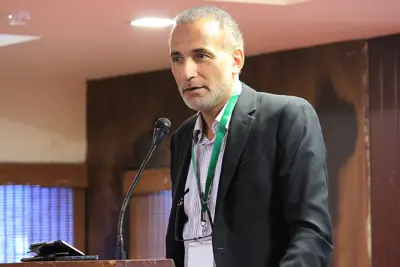
Tariq Ramadan is a Swiss Muslim academic, philosopher, and writer. He was a professor of contemporary Islamic studies at St Antony's College, Oxford and the Faculty of Theology and Religion, University of Oxford, but as of 2018 is taking an agreed leave of absence. He is a visiting professor at the Faculty of Islamic Studies at Hamad Bin Khalifa University in Qatar, and the Université Mundiapolis in Morocco. He is also a senior research fellow at Doshisha University in Japan. He is the director of the Research Centre of Islamic Legislation and Ethics (CILE), based in Doha. He is a member of the UK Foreign Office Advisory Group on Freedom of Religion or Belief. He was elected by Time magazine in 2000 as one of the seven religious innovators of the 21st century and in 2004 as one of the 100 most influential people in the world and by Foreign Policy readers (2005, 2006, 2008–2010, 2012–2015) as one of the top 100 most influential thinkers in the world and Global Thinkers. Ramadan describes himself as a "Salafi reformist".
