Tariq Ramadan Quotes
Drafting of the constitutions is interesting and the discussions around them revealing in many ways. I take it as a discussion of very important symbols revealing many different problems. My take at the beginning was to warn that Tunisia might be the only successful country, the only one to justify us in talking about the spring, while all the other countries were less successful, if not failing. Now the point is that even in Tunisia it is not going to be easy, and this is where we have a problem.
Ramadan, Tariq. "Turkey is not the model. Secularists and Islamists are both wrong." Interview by Reset-Dialogues on Civilizations. Reset DOC, 28 May 2013.


The incident to which he referred was Islamic extremist terrorists attacking with assault weapons a group of unarmed tourists killing over 30. Tunisia, although it has a large majority Muslim population, became a secular republic after its Arab Spring revolution. Tunisia's economy is dependent on tourism, which is diminished by the fear of more terrorist attacks.


This illustrates the major problem of establishing democracy in an Islamic nation. If the mainstream of Islamic people accept democracy as in Turkey, there can be a vibrant democracy. But if the mainstream sees all other religions as heresy and insists on a literal interpretation of the Koran, then democracy is impossible as in Saudi Arabia.


Even the CIA and the other U. S. Intelligence missed predicting the Arab Spring, but so did the intelligence services of all our allies, Russia, China and even Israel which usually has the best intelligence in the Middle East. One of the reasons he argues is that media and technology played such an important role in facilitating the Arab Spring and the intelligence agencies do not really understand the new media world. The people who do some argue are too young to ever be in enough key positions in these agencies to have much influence.


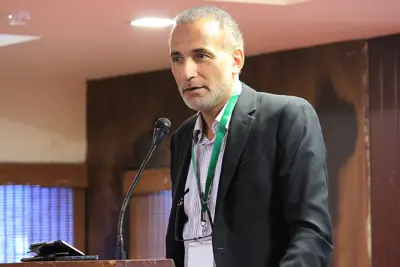
Tariq Ramadan is a Swiss Muslim academic, philosopher, and writer. He was a professor of contemporary Islamic studies at St Antony's College, Oxford and the Faculty of Theology and Religion, University of Oxford, but as of 2018 is taking an agreed leave of absence. He is a visiting professor at the Faculty of Islamic Studies at Hamad Bin Khalifa University in Qatar, and the Université Mundiapolis in Morocco. He is also a senior research fellow at Doshisha University in Japan. He is the director of the Research Centre of Islamic Legislation and Ethics (CILE), based in Doha. He is a member of the UK Foreign Office Advisory Group on Freedom of Religion or Belief. He was elected by Time magazine in 2000 as one of the seven religious innovators of the 21st century and in 2004 as one of the 100 most influential people in the world and by Foreign Policy readers (2005, 2006, 2008–2010, 2012–2015) as one of the top 100 most influential thinkers in the world and Global Thinkers. Ramadan describes himself as a "Salafi reformist".
