Adlai Stevenson I Quotes
The men who run the Eisenhower Administration evidently believe that the minds of Americans can be manipulated by shows, slogans and the arts of advertising. This idea that you can merchandise candidates for high office like breakfast cereal -- that you can gather votes like box tops -- is, I think, the ultimate indignity to the democratic process
This is a fascinating quotation because it illustrates how political attitudes have changed since then. Stevenson meant this to be an insult to and even a charge against the men who ran the Eisenhower administration and campaign but not the President personally. And that was the way that it was taken. Republicans were insulted and thought this was a scurrilous charge by a candidate who was down in the polls but wanted to throw “red meat” to his base. However, when we read the statement today, it doesn’t seem at all like an insult. As a matter of fact, there are few politicians today, of either party, who would not agree with the views that Stevenson accuses the Republican strategists of having. Arguably, the Democrats were historically very slow to arrive at he place the Republicans had achieved. But in 1956 it was almost unethical to use shows and advertising techniques to manipulate public opinion. Politicians had been doing it since the beginning of our Republic but it used to be something a little dirty—something to which no one wanted to public admit believing. Today, politicians of both parties are often criticized by their base and the pundits for not believing sufficiently in the importance of image manipulation and advertising. Today, virtually no politicians have any moral scruples about using the techniques, doing so overtly and being proud of their staffs for being good at it.
Adlai Stevenson, 1900-1965, U. S. Congressman (Democrat, IL), Governor of Illinois, Democratic candidate for President, U. S. Ambassador to the United Nations, Presidential Nomination Acceptance Speech, Democratic National Convention, Chicago, 1956
Sourced by: Eigen's Political and Historical Quotations

Sinclair was a writer who had written about some of the worst scandals in American politics, leaned toward socialized democracy, and decided to run as a reform candidate in California where he lived. He won the Democratic primary easily even though he had no money, political experience, or backing. He terrified the Republicans who ran one of the dirtiest campaigns in American History to defeat him spending more money than in any election up to then including the Presidential elections. (for more details see {619613}) Sinclair lost, but it was close.


Television had been used very effectively in the 1952 and 1956 Presidential elections, particularly by the Republicans, and by 1960 both parties were planning extensive use of TV in the coming election.


Accusing her of being a fellow traveler with Communist sympathies, Nixon called her "the Pink Lady" and said she was "pink right down to her underwear." See {627826} and {619498}. Douglas and her campaign thought the accusations were so absurd that at first they did not even bother to respond. Nixon repeated the them and stayed “on message” and by the time that Douglas, who had opposed communism all her life, was believed to be one or at least a “fellow traveler” by most Californians—and finally she responded with statements like this, but it was way too late to turn public perception around. She awarded Nixon the derogatory nickname “Tricky Dick” which the majority of the public used for him throughout his career--{600036}.

The ad, created by Tony Schwartz, only ran once, on September 7, 1964. It was so dramatic that News and other media replayed it and discussed it up until the election. LBJ’s opponent Barry Goldwater was a military hawk in the midst of the Cold war where nuclear war was everyone’s greatest fear. The Daisy ad was crystal clear and made overt what many Americans concern was about Goldwater. Johnson won in a landslide. See {586351} for the kinds of views that made Goldwater so vulnerable.

What is amazing about this quotation is that it shows the naivety of one of the most sophisticated politicians in the country. He and many politicians were really surprised that commercial consumer marketing techniques would work so well. He and many others thought that the issue of marketing political candidates was something that should be debated. Meanwhile, all the pragmatic politicians of both political parties jumped on the commercial marketing bandwagon, but the Republicans tended to master and execute the techniques more skillfully.
Many studies have shown that most of us believe that commercial, political, and ideological advertising techniques are effective on most people but they do not feel that they are personally influenced much.


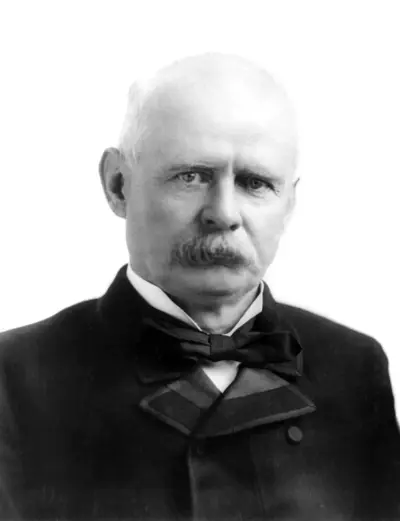
Adlai Ewing Stevenson served as the 23rd vice president of the United States from 1893 to 1897. Previously, he served as a representative from Illinois in the late 1870s and early 1880s. After his subsequent appointment as assistant postmaster general of the United States during Grover Cleveland's first administration (1885–1889), he fired many Republican postal workers and replaced them with Southern Democrats. This earned him the enmity of the Republican-controlled Congress, but made him a favorite as Grover Cleveland's running mate in 1892, and he duly became vice president of the United States.
